If you’ve ever used ChatGPT, you’ve already experienced one of OpenAI’s most well-known creations.
But OpenAI is much more than a single chatbot.
Over the past decade, the company has become one of the most influential organizations in artificial intelligence, helping transform AI from a technology known mostly by researchers into a tool used by hundreds of millions of people around the world.
Its journey has included groundbreaking discoveries, rapid growth, major partnerships, and difficult challenges.
So, how did OpenAI become one of the biggest names in AI?
Let’s take a look.
What Is OpenAI?
OpenAI is an artificial intelligence research and technology company dedicated to developing advanced AI systems.
Its mission is simple but ambitious:
To ensure that artificial general intelligence (AGI) benefits all of humanity.
Rather than focusing on a single product, OpenAI researches and develops AI models that can help people learn, create, solve problems, and become more productive.
Today, its technology powers some of the world’s most widely used AI applications.
The Beginning
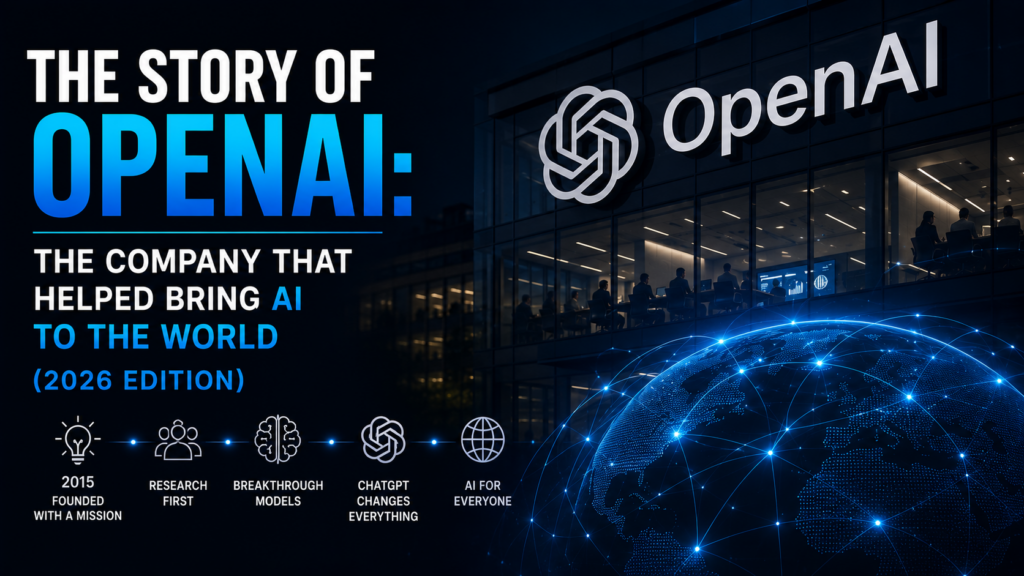
OpenAI was founded in December 2015 by a group of entrepreneurs, researchers, and technology leaders who believed artificial intelligence would become one of the most important technologies of the future.
Among the founding figures were:
- Sam Altman
- Elon Musk
- Greg Brockman
- Ilya Sutskever
- Wojciech Zaremba
- John Schulman
Their original vision was to advance AI research while encouraging its safe and responsible development.
The founders believed that if AI became extremely powerful, its benefits should be shared broadly rather than controlled by only a few organizations.
From Research Lab to Industry Leader
During its early years, OpenAI focused primarily on research.
The company published scientific papers, developed new AI techniques, and released research that helped advance the entire field.
Rather than immediately building consumer products, OpenAI concentrated on solving difficult technical challenges.
Over time, however, its research began producing increasingly powerful AI models.
That shift would eventually change the technology industry.
The GPT Series
One of OpenAI’s biggest breakthroughs came with the development of the Generative Pre-trained Transformer (GPT) family of language models.
Each new generation became significantly more capable.
The GPT models demonstrated improvements in:
- Writing
- Summarization
- Translation
- Coding
- Reasoning
- Conversation
These advances showed that AI could do much more than answer simple questions.
It could become a practical assistant for everyday work and learning.
ChatGPT Changes Everything
On November 30, 2022, OpenAI released ChatGPT to the public.
Few people expected what happened next.
Within days, millions of people were experimenting with conversational AI.
Students used it to study.
Businesses used it to improve productivity.
Writers brainstormed ideas.
Programmers generated code.
Teachers explored new classroom possibilities.
For many people, ChatGPT became their first direct experience with advanced artificial intelligence.
Its rapid adoption sparked worldwide interest in AI unlike anything seen before.
Beyond ChatGPT
Although ChatGPT is OpenAI’s most recognizable product, the company has developed many other AI technologies.
Its work includes models capable of:
- Understanding language
- Generating images
- Creating computer code
- Analyzing documents
- Processing speech
- Supporting scientific research
These technologies continue evolving as AI research advances.
Partnership with Microsoft
One of OpenAI’s most significant business relationships has been its partnership with Microsoft.
Microsoft invested billions of dollars into OpenAI and integrated its technology into many products and services.
This partnership helped expand access to AI through tools used by businesses, students, and professionals around the world.
It also accelerated competition across the technology industry, encouraging many companies to develop their own AI systems.
OpenAI’s Mission
OpenAI has consistently emphasized that developing increasingly capable AI also requires careful attention to safety and responsibility.
The company invests heavily in research involving:
- AI safety
- Responsible deployment
- Model evaluation
- Alignment with human values
- Security
- Reducing harmful outputs
As AI becomes more powerful, balancing innovation with responsibility remains one of the company’s central goals.
Challenges Along the Way
Like many fast-growing technology companies, OpenAI has faced its share of challenges.
These have included discussions surrounding:
- AI safety
- Copyright concerns
- Privacy
- Competition
- Regulation
- The future of work
- Leadership changes
These conversations reflect broader questions facing the entire AI industry as governments, researchers, businesses, and the public work to understand how advanced AI should be developed and used responsibly.
OpenAI’s Impact on the World
OpenAI’s influence extends far beyond one company.
Its work has accelerated AI development across nearly every industry.
Today, AI is being used in:
- Education
- Healthcare
- Business
- Software development
- Customer service
- Scientific research
- Marketing
- Content creation
- Accessibility
Perhaps OpenAI’s greatest contribution has been making advanced AI accessible to everyday people rather than limiting it to research laboratories.
Frequently Asked Questions
What is OpenAI?
OpenAI is an artificial intelligence research and technology company that develops advanced AI systems, including ChatGPT.
Who founded OpenAI?
OpenAI was founded in 2015 by a group of entrepreneurs and researchers, including Sam Altman, Elon Musk, Greg Brockman, Ilya Sutskever, Wojciech Zaremba, and John Schulman.
Is OpenAI the same as ChatGPT?
No.
OpenAI is the company.
ChatGPT is one of the products developed by OpenAI.
What does GPT stand for?
GPT stands for Generative Pre-trained Transformer, the family of language models that power ChatGPT and related AI systems.
Why is OpenAI important?
OpenAI helped introduce advanced conversational AI to hundreds of millions of people, dramatically increasing public awareness and everyday use of artificial intelligence.
Final Thoughts
Throughout history, certain companies have helped define entire technological eras.
IBM helped shape the early age of computing.
Google transformed how people search for information.
Apple changed the way millions interact with personal technology.
OpenAI has played a similar role in the modern AI revolution.
By developing powerful language models and introducing ChatGPT to the public, the company helped move artificial intelligence from research labs into classrooms, offices, homes, and businesses around the world.
Its work has inspired innovation, competition, and important conversations about the future of technology.
Whether discussing productivity, education, creativity, or scientific discovery, it’s difficult to tell the story of modern artificial intelligence without talking about OpenAI.
As AI continues to evolve, OpenAI will almost certainly remain one of the organizations helping shape what comes next—and its story is still being written.