Artificial intelligence has advanced more in the past decade than many experts thought possible.
Today’s AI can write essays, generate images, translate languages, recognize speech, and even help scientists make new discoveries.
But these breakthroughs didn’t happen overnight.
Behind many of today’s most impressive AI systems is the work of one researcher whose ideas transformed the field.
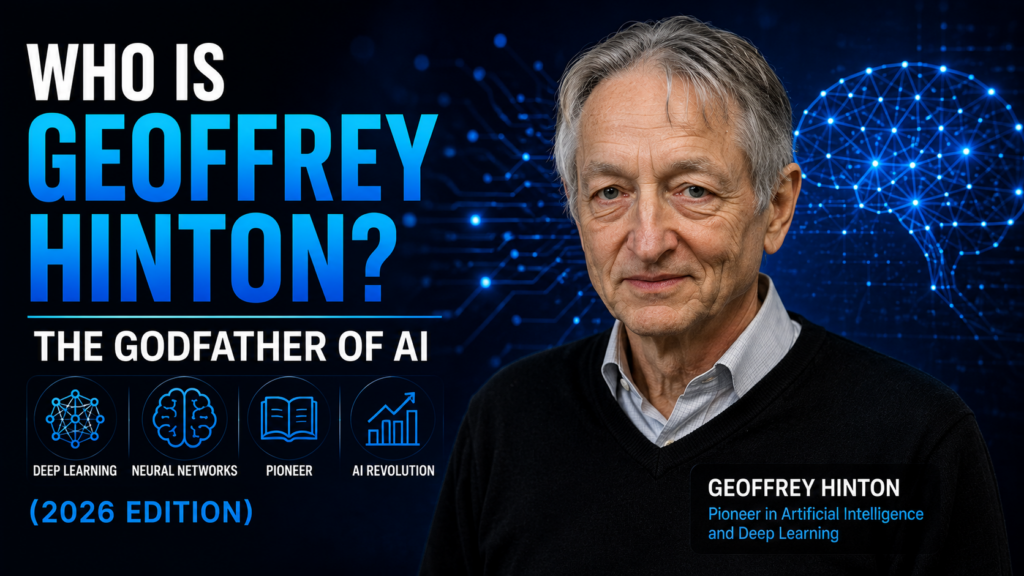
His name is Geoffrey Hinton.
Often called “The Godfather of AI,” Hinton spent decades researching ideas that many people once believed would never work. His persistence helped lay the foundation for the AI revolution we see today.
Early Life
Geoffrey Hinton was born on December 6, 1947, in London, England.
Growing up, he developed a deep interest in science, mathematics, and understanding how intelligence works.
Rather than asking how computers could simply follow instructions, Hinton wanted to answer a much bigger question:
How does the human brain learn?
That curiosity would shape the rest of his career.
He later earned a doctorate in Artificial Intelligence from the University of Edinburgh, where he began exploring ideas that would eventually change the future of AI.
Thinking Differently
During the 1970s and 1980s, many AI researchers focused on creating systems that followed carefully written rules.
The idea was simple:
If people could write enough rules, computers could become intelligent.
Hinton believed there was a better approach.
Instead of programming every rule by hand, he thought computers should learn from data, much like humans learn from experience.
At the time, many researchers were skeptical.
Computers weren’t powerful enough to prove his ideas.
Still, Hinton continued his research.
The Power of Neural Networks
One of Geoffrey Hinton’s greatest contributions was helping advance artificial neural networks.
A neural network is a computer system inspired by the way neurons in the human brain are connected.
Rather than following a fixed set of instructions, neural networks learn by identifying patterns in large amounts of information.
Today, neural networks help power:
- AI assistants
- Image recognition
- Speech recognition
- Language translation
- Recommendation systems
- Self-driving vehicle research
- Medical image analysis
Although many researchers contributed to this field, Hinton became one of its strongest advocates during a time when few others believed it would succeed.
Deep Learning Changes Everything
For many years, neural networks struggled because computers simply weren’t fast enough.
As technology improved, Hinton and other researchers showed that larger neural networks trained with more data could solve incredibly difficult problems.
This approach became known as Deep Learning.
Deep Learning dramatically improved AI’s ability to:
- Recognize images
- Understand speech
- Translate languages
- Generate text
- Learn complex patterns
Today, Deep Learning forms the foundation of many of the world’s most advanced AI systems.
The ImageNet Breakthrough
One of the biggest turning points in modern AI came in 2012.
A team led by Geoffrey Hinton developed an AI system that dramatically outperformed previous methods in the ImageNet image recognition competition.
Their system identified objects in photographs far more accurately than competing approaches.
The victory shocked the AI community.
Suddenly, many researchers realized that Deep Learning wasn’t just an interesting theory.
It worked.
After that breakthrough, investment in Deep Learning accelerated around the world.
Many historians consider this one of the events that launched today’s AI revolution.
Helping Shape Today’s AI
Hinton’s research influenced nearly every area of modern artificial intelligence.
His work helped inspire advances in:
- Chatbots
- Large Language Models
- Computer Vision
- Speech Recognition
- Robotics
- Medical AI
- Scientific Research
Companies and universities around the world began investing heavily in Deep Learning after seeing its potential.
Although thousands of researchers have contributed to modern AI, many of them built upon ideas Hinton spent decades developing.
Why He’s Called the “Godfather of AI”
The nickname “The Godfather of AI” reflects Hinton’s enormous influence on the field.
It doesn’t mean he invented Artificial Intelligence by himself.
Many pioneers—including Alan Turing, John McCarthy, Marvin Minsky, and others—made essential contributions.
What makes Hinton unique is that his research helped turn AI from an academic field into technology capable of solving real-world problems at an extraordinary scale.
His work influenced the generation of AI systems that millions of people use today.
Speaking Openly About AI’s Future
As AI has become more powerful, Geoffrey Hinton has also spoken publicly about both its opportunities and its risks.
He believes AI has the potential to improve:
- Healthcare
- Scientific research
- Education
- Productivity
- Accessibility
At the same time, he has encouraged governments, researchers, and technology companies to think carefully about AI safety and responsible development.
His willingness to discuss both the benefits and the challenges has made him an important voice in conversations about AI’s future.
Awards and Recognition
Throughout his career, Geoffrey Hinton has received numerous honors for his groundbreaking work.
Among the most notable is the 2018 Turing Award, often referred to as the “Nobel Prize of Computing,” which he shared with Yann LeCun and Yoshua Bengio for their pioneering contributions to deep learning.
His research has influenced countless scientists, engineers, and technology companies around the world.
Today, many of the AI tools people use every day rely on ideas that Hinton helped develop over decades of research.
Frequently Asked Questions
Who is Geoffrey Hinton?
Geoffrey Hinton is a British-Canadian computer scientist and cognitive psychologist whose research on neural networks and deep learning helped shape modern artificial intelligence.
Why is Geoffrey Hinton called the Godfather of AI?
He spent decades advancing neural networks and deep learning during a time when many researchers doubted they would succeed. His work became one of the foundations of today’s AI systems.
Did Geoffrey Hinton invent AI?
No.
Artificial Intelligence has many pioneers.
Hinton’s greatest contribution was helping develop and popularize deep learning, one of the technologies powering modern AI.
What is Geoffrey Hinton most famous for?
He is best known for his work on artificial neural networks, deep learning, and the ImageNet breakthrough that helped accelerate today’s AI revolution.
Final Thoughts
History often celebrates the moment a technology becomes successful.
It sometimes overlooks the decades of research that made that success possible.
Geoffrey Hinton spent much of his career believing in ideas that many others dismissed. He continued exploring neural networks and machine learning even when computing power wasn’t ready to support them.
Eventually, the technology caught up with the vision.
Today, millions of people benefit from breakthroughs built upon the ideas Hinton helped advance—from voice assistants and language translation to image recognition and conversational AI.
His story reminds us that scientific progress often requires patience, persistence, and the courage to keep exploring ideas long before the rest of the world recognizes their value.
As artificial intelligence continues to evolve, Geoffrey Hinton’s influence will remain woven into its history, not because he built every AI system, but because he helped make today’s AI revolution possible.