
Artificial intelligence has made incredible progress over the past few years.
AI can write articles, answer questions, create artwork, translate languages, generate computer code, and even help scientists with research.
But despite these impressive abilities, today’s AI still has important limitations.
It can perform many specific tasks extremely well.
It cannot truly understand the world the way humans do.
That’s where the idea of Artificial General Intelligence, often called AGI, comes in.
Many researchers believe AGI could represent the next major step in the evolution of artificial intelligence.
But what exactly is it?
Let’s take a closer look.
What Does AGI Mean?
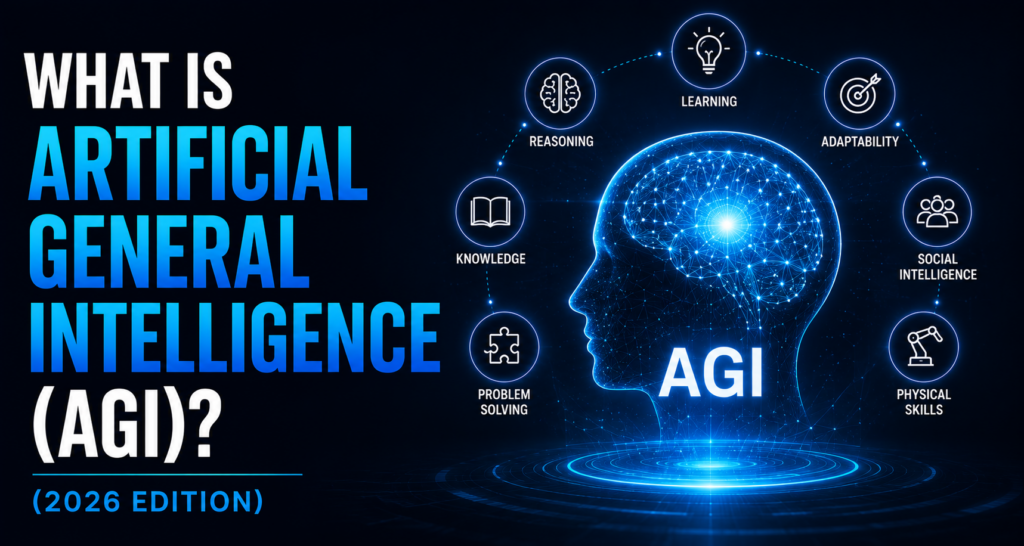
Artificial General Intelligence (AGI) refers to a theoretical type of AI that could learn, reason, and solve problems across many different areas—much like a human being.
Unlike today’s AI systems, AGI wouldn’t be limited to one type of task.
Instead, it could adapt to entirely new situations without requiring specialized training for every job.
In simple terms:
Today’s AI is designed to do specific tasks.
AGI would be able to learn and perform almost any intellectual task that a person can.
How Is Today’s AI Different?
The AI tools we use today are often called Narrow AI or Specialized AI.
They’re extremely good at the jobs they were designed to perform.
For example:
- AI can recognize faces in photos.
- AI can translate languages.
- AI can recommend movies.
- AI can write emails.
- AI can generate computer code.
But these systems don’t truly understand the world.
An AI that excels at writing stories can’t automatically perform surgery.
An AI trained to recognize tumors can’t suddenly become a financial advisor.
Each system is designed for a specific purpose.
What Would AGI Be Able to Do?
If AGI is ever achieved, it could potentially:
- Learn new skills independently.
- Solve unfamiliar problems.
- Understand context across many subjects.
- Apply knowledge from one field to another.
- Adapt to new situations without extensive retraining.
- Reason through complex decisions.
- Learn continuously from experience.
For example:
Imagine teaching someone how to ride a bicycle.
Later, that same person can usually learn to drive a car more easily because they understand balance, movement, traffic, and coordination.
Today’s AI generally doesn’t transfer knowledge that way.
AGI, in theory, could.
Why Is AGI So Difficult?
Human intelligence is incredibly complex.
People don’t just memorize facts.
We:
- Learn from experience.
- Understand emotions.
- Apply common sense.
- Adapt to unexpected situations.
- Make creative connections.
- Solve problems using reasoning.
Researchers still don’t fully understand every aspect of human intelligence.
Because of that, creating AGI remains one of the greatest scientific challenges in history.
Does AGI Exist Today?
No.
Despite impressive advances in artificial intelligence, there is no confirmed Artificial General Intelligence today.
Current AI systems can appear intelligent because they’re exceptionally good at specific tasks.
However, they still have limitations.
They may:
- Forget previous conversations.
- Generate incorrect information.
- Struggle with unfamiliar situations.
- Lack true understanding.
- Require human guidance.
Researchers continue working toward more capable AI systems, but AGI has not yet been achieved.
Why Are So Many People Talking About AGI?
Interest in AGI has grown rapidly because modern AI has advanced much faster than many experts expected.
Recent breakthroughs in:
- Language models
- Robotics
- Machine learning
- Deep learning
- Scientific research
have made people wonder how much further AI could eventually progress.
Some researchers believe AGI could arrive within decades.
Others believe it may take much longer—or may never be achieved.
The truth is that no one knows for certain.
Potential Benefits of AGI
If developed responsibly, AGI could help humanity solve some of its biggest challenges.
Possible benefits include:
- Accelerating medical research
- Discovering new medicines
- Improving education
- Advancing scientific discoveries
- Solving complex engineering problems
- Responding to natural disasters
- Improving accessibility for people with disabilities
- Increasing productivity across many industries
These possibilities are one reason researchers continue investing heavily in AI research.
Potential Risks
Because AGI could be extremely powerful, many researchers believe it should be developed carefully.
Some concerns include:
- Safety
- Security
- Privacy
- Job disruption
- Misuse by bad actors
- Ethical decision-making
- Alignment with human values
Researchers around the world are actively studying how to build advanced AI systems responsibly.
The goal isn’t simply creating more capable AI.
It’s creating AI that benefits humanity.
Common Misconceptions
“AGI already exists.”
No.
Today’s AI is impressive, but it remains specialized rather than generally intelligent.
“AGI will immediately replace humans.”
There is no evidence supporting that claim.
Even if AGI is developed someday, how it would be used depends on many technical, ethical, legal, and societal decisions.
“ChatGPT is AGI.”
No.
ChatGPT is a powerful conversational AI system, but it remains a specialized tool designed to assist with language-related tasks.
It is not considered Artificial General Intelligence.
“Scientists know exactly when AGI will arrive.”
No one knows.
Predictions vary widely, and there is no consensus within the research community.
Frequently Asked Questions
What does AGI stand for?
AGI stands for Artificial General Intelligence.
Is AGI real today?
No.
Researchers continue working toward AGI, but there is no confirmed AGI system available today.
What’s the difference between AI and AGI?
Today’s AI performs specific tasks.
AGI would be capable of learning and performing many different intellectual tasks in a flexible way, similar to human learning.
Will AGI replace jobs?
No one knows.
If AGI is eventually developed, its impact will depend on how it is implemented, regulated, and adopted by society.
Final Thoughts
Artificial General Intelligence is one of the most fascinating ideas in modern technology.
It represents the possibility of creating AI that can learn, reason, adapt, and solve problems across many different areas rather than excelling at just one.
For now, AGI remains a goal—not a reality.
Today’s AI systems are already transforming education, healthcare, business, creativity, and scientific research, but they are still specialized tools with important limitations.
Whether AGI arrives in the next few decades, much later, or proves more difficult than expected, one thing is certain:
The conversation surrounding Artificial General Intelligence will continue shaping the future of technology for years to come.
As researchers push the boundaries of what’s possible, understanding the difference between today’s AI and tomorrow’s possibilities will help you follow one of the most important technological stories of our time.
At MasterAIBasics, we’ll continue explaining these developments in clear, practical language so you can stay informed without getting lost in technical jargon or sensational headlines.