
If you’ve spent any time reading about artificial intelligence, you’ve probably come across three terms over and over again:
- Artificial Intelligence (AI)
- Machine Learning (ML)
- Deep Learning (DL)
At first glance, they seem interchangeable. Many news articles and social media posts even use them as if they mean the same thing.
But they don’t.
The good news is that understanding the difference is much easier than you might think.
In this guide, we’ll explain each term in plain English, show how they’re connected, and help you understand why these technologies are changing the world.
The Simple Answer
Think of the relationship like this:
Artificial Intelligence is the biggest category.
Inside AI is Machine Learning.
Inside Machine Learning is Deep Learning.
You can picture it like three nested circles.
- Artificial Intelligence is the largest circle.
- Machine Learning is a smaller circle inside AI.
- Deep Learning is an even smaller circle inside Machine Learning.
In other words:
Every deep learning system is a machine learning system, and every machine learning system is part of artificial intelligence—but not every AI system uses machine learning, and not every machine learning system uses deep learning.
What Is Artificial Intelligence?
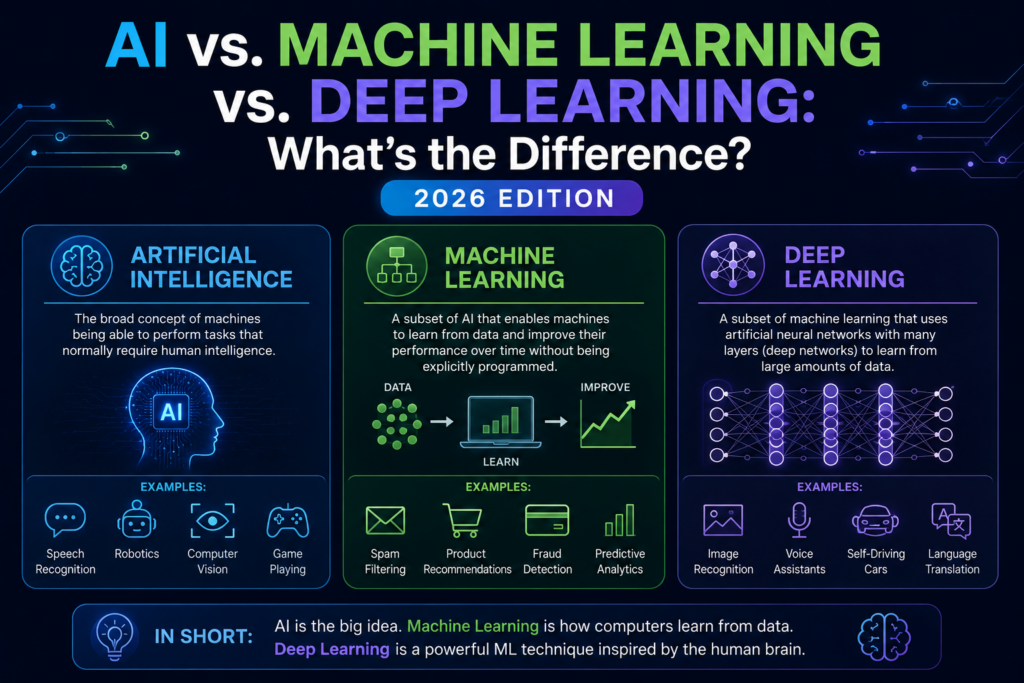
Artificial Intelligence is the broad concept of creating computers that can perform tasks that normally require human intelligence.
Those tasks might include:
- Understanding language
- Solving problems
- Making recommendations
- Recognizing images
- Playing games
- Planning routes
- Answering questions
AI isn’t one specific technology.
Instead, it’s an entire field of computer science focused on making machines perform intelligent tasks.
Think of AI as the umbrella that covers many different technologies.
What Is Machine Learning?
Machine Learning is one way of building AI systems.
Instead of programming every rule by hand, developers allow the computer to learn from data.
Imagine teaching a child to recognize cats.
You could describe every possible feature:
- Pointed ears
- Whiskers
- Fur
- Tail
- Four legs
Or…
You could simply show them thousands of pictures of cats.
Eventually, they begin recognizing cats on their own.
Machine learning works in a similar way.
Instead of following only fixed instructions, it learns patterns from large amounts of data.
That’s why machine learning has become so powerful.
What Is Deep Learning?
Deep Learning is a more advanced type of machine learning.
It uses artificial neural networks—computer systems inspired by the way neurons in the human brain are connected—to recognize extremely complex patterns.
While that sounds technical, here’s a simple way to think about it.
If machine learning is like teaching someone with thousands of examples…
Deep learning is like giving them millions of examples and allowing them to discover much more detailed patterns.
Deep learning excels at tasks such as:
- Speech recognition
- Image recognition
- Language translation
- Self-driving technology
- AI image generation
- Modern chatbots
Many of today’s most impressive AI breakthroughs are powered by deep learning.
A Real-World Example
Imagine you’re creating software that recognizes dogs in photographs.
Traditional AI
A programmer writes detailed rules:
- Dogs have four legs.
- Dogs have ears.
- Dogs have tails.
This works for simple situations but struggles when photos become more complicated.
Machine Learning
Instead of writing every rule, you feed the computer thousands of labeled dog photos.
Over time, it learns the patterns that make a dog look like a dog.
Its accuracy improves as it processes more examples.
Deep Learning
Now imagine showing the computer millions of dog photos.
It begins recognizing subtle differences between breeds, lighting conditions, camera angles, backgrounds, and partially hidden animals.
That’s why deep learning often performs much better on complex tasks.
Why Does This Matter?
You don’t need to become a programmer to benefit from understanding these terms.
Knowing the difference simply helps you better understand the technology you’re already using.
For example:
When someone says:
“AI created this image.”
The technology behind it is often deep learning.
When Netflix recommends a movie…
Machine learning is likely helping predict what you might enjoy.
When your phone recognizes your face to unlock the screen…
Deep learning is probably doing much of the work.
Although people often say “AI,” different technologies may be working behind the scenes.
Everyday Examples
Artificial Intelligence
- Virtual assistants
- Navigation apps
- Smart home devices
- Customer service chatbots
- Game opponents
Machine Learning
- Email spam filters
- Product recommendations
- Fraud detection
- Predictive text
- Personalized advertisements
Deep Learning
- Facial recognition
- Voice assistants
- Language translation
- AI-generated images
- Modern AI chatbots
- Self-driving vehicle technology
Which One Is Most Powerful?
Each serves a different purpose.
Artificial Intelligence is the overall goal.
Machine Learning is one of the most successful ways to build intelligent systems.
Deep Learning is a specialized approach that performs especially well on large, complex problems involving images, language, audio, and massive amounts of data.
Rather than competing with one another, they work together.
Common Misconceptions
“AI and Machine Learning are the same thing.”
Not quite.
Machine learning is one branch of artificial intelligence.
“Deep Learning replaces Machine Learning.”
No.
Deep learning is actually a specialized form of machine learning.
“All AI learns by itself.”
Not always.
Some AI systems still rely on rules created by programmers rather than learning from data.
“You need to understand programming to understand AI.”
Absolutely not.
Many people successfully use AI every day without ever writing a single line of code.
Frequently Asked Questions
Which came first?
Artificial Intelligence came first as the broader field of study.
Machine Learning later became one of the most successful ways to build AI systems, and Deep Learning developed as a specialized branch of Machine Learning.
Does ChatGPT use deep learning?
Yes.
Modern conversational AI systems like ChatGPT are built using advanced deep learning techniques that allow them to understand and generate natural language.
Which technology is used the most today?
All three play important roles, but many of today’s most advanced AI applications—including image generation, speech recognition, and conversational AI—rely heavily on deep learning.
Should beginners worry about the technical details?
Not at all.
Understanding the basic relationship between AI, Machine Learning, and Deep Learning is enough for most people who simply want to use AI tools effectively.
Final Thoughts
Artificial Intelligence, Machine Learning, and Deep Learning are closely related, but they aren’t the same thing.
Think of AI as the broad field of creating intelligent machines. Machine Learning is one method that allows computers to learn from data instead of following only fixed rules. Deep Learning takes that idea a step further by using advanced neural networks to solve highly complex problems.
As you continue exploring AI, you’ll hear these terms often. Now you’ll know exactly how they fit together.
The important thing isn’t memorizing technical definitions—it’s understanding the big picture. Once you grasp that relationship, news articles, AI tools, and technology discussions become much easier to follow.
And if you’re just beginning your AI journey, don’t worry. You don’t need to become an engineer to benefit from artificial intelligence. Understanding the basics is enough to start using today’s AI tools with confidence.