One of the most valuable AI skills you can learn doesn’t require programming.
It doesn’t require advanced mathematics.
And it doesn’t require a computer science degree.
It simply requires learning how to ask better questions.
This skill is known as Prompt Engineering.
Although the name sounds highly technical, prompt engineering is something anyone can learn. Whether you’re using AI to write emails, create images, solve problems, or brainstorm business ideas, the quality of your prompt often determines the quality of the AI’s response.
In other words:
Better prompts usually produce better results.
Let’s explore what prompt engineering is, why it matters, and how you can immediately improve your conversations with AI.
What Is a Prompt?
Before we discuss prompt engineering, let’s define a prompt.
A prompt is simply the instruction, question, or request you give an AI.
For example:
- “Explain photosynthesis.”
- “Write a professional email.”
- “Create a weekly meal plan.”
- “Generate a logo idea.”
- “Summarize this article.”
Every conversation with an AI begins with a prompt.
What Is Prompt Engineering?
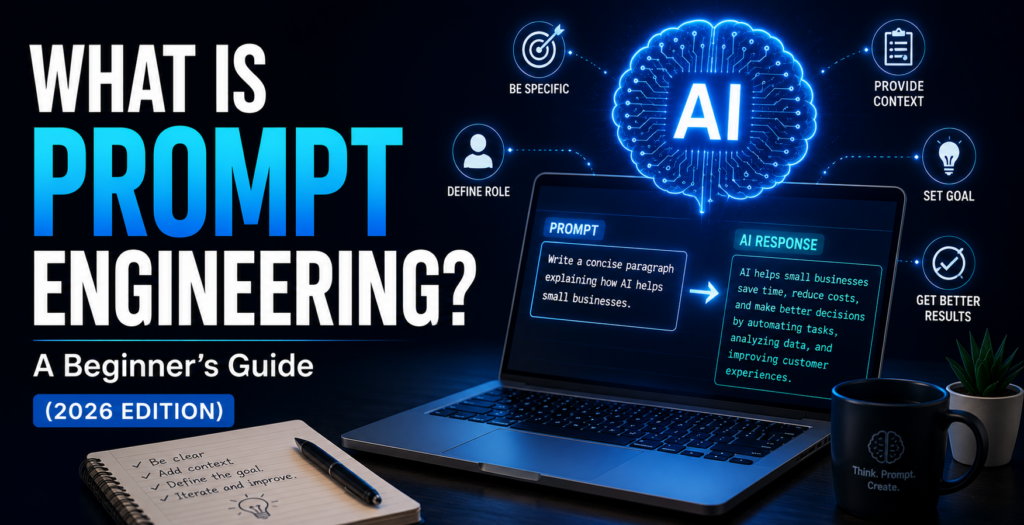
Prompt engineering is the process of writing clear, detailed, and effective prompts that help AI produce better responses.
Think of it this way.
Imagine asking a contractor:
“Build me a house.”
You’d probably have a lot of follow-up questions.
Now imagine saying:
“Build a three-bedroom ranch-style home with a two-car garage, modern kitchen, hardwood floors, and a covered back patio.”
The second request gives far more useful information.
AI works the same way.
The more helpful context you provide, the more useful the response is likely to be.
Why Prompt Engineering Matters
Artificial intelligence doesn’t read your mind.
It only knows what you tell it.
A vague prompt often produces a vague answer.
A detailed prompt usually produces a more useful response.
Prompt engineering helps you:
- Save time
- Reduce revisions
- Improve accuracy
- Generate better ideas
- Receive more personalized responses
- Get higher-quality results
Learning this one skill can dramatically improve your AI experience.
Weak Prompt vs. Strong Prompt
Let’s look at a simple example.
Weak Prompt
Write an email.
The AI has almost no information.
Better Prompt
Write a friendly email to my manager requesting Friday off for a family event. Keep it professional and under 150 words.
Notice the difference.
The second prompt tells the AI:
- Who the email is for
- The purpose
- The tone
- The length
As a result, the response will usually be much more useful.
The Five Ingredients of a Great Prompt
One of the easiest ways to improve your prompts is to include five key pieces of information whenever possible.
1. Tell the AI What You Want
Be clear about your goal.
Instead of:
Help me.
Try:
Create a one-week beginner workout plan.
2. Provide Context
Explain the situation.
For example:
I’m starting my first small business and need help creating a marketing plan.
Context helps AI understand your needs.
3. Describe the Audience
Who is the content for?
Examples:
- Beginners
- Students
- Business owners
- Parents
- Teachers
- Children
Knowing the audience helps AI adjust its writing style.
4. Choose the Tone
Tell the AI how you’d like the response to sound.
Examples include:
- Professional
- Friendly
- Casual
- Humorous
- Inspirational
- Formal
- Conversational
5. Specify the Format
Tell the AI how you want the information presented.
Examples:
- Bullet points
- Table
- Step-by-step guide
- Article
- Checklist
- Script
- Social media post
Formatting instructions often save time by reducing the need for revisions.
Prompt Engineering Examples
Example 1
Instead of:
Tell me about dogs.
Try:
Explain why Golden Retrievers make good family pets for someone who has never owned a dog.
Example 2
Instead of:
Write an article.
Try:
Write a 1,500-word beginner-friendly article explaining how artificial intelligence helps small businesses. Use simple language, include headings, FAQs, and a conclusion.
Example 3
Instead of:
Make an image.
Try:
Create a realistic image of a black Labrador sitting beside a peaceful lake at sunrise with soft golden lighting and mountains in the background.
More details almost always produce better results.
Common Prompt Engineering Mistakes
Many beginners accidentally make prompts harder for AI to understand.
Common mistakes include:
- Being too vague
- Leaving out important details
- Asking multiple unrelated questions at once
- Expecting AI to know personal preferences without explaining them
- Accepting the first answer without asking follow-up questions
Remember…
AI conversations don’t have to end after one response.
You can continue refining the result.
You Can Keep Improving the Response
One of AI’s greatest strengths is that you can ask it to revise its work.
For example:
- Make it shorter.
- Explain it more simply.
- Add examples.
- Rewrite it professionally.
- Use bullet points.
- Make it more persuasive.
- Add humor.
- Expand section three.
Many experienced AI users rarely settle for the first response.
Instead, they improve it through conversation.
Is Prompt Engineering Difficult?
Not at all.
Despite the impressive name, prompt engineering is really about learning to communicate clearly.
The better you become at describing what you want, the better AI becomes at helping you.
Like any skill, it improves with practice.
Frequently Asked Questions
Do I need to know programming to use prompt engineering?
No.
Prompt engineering uses everyday language.
Anyone who can describe what they want can learn to write effective prompts.
Is prompt engineering only for ChatGPT?
No.
Prompt engineering works with many AI tools, including Claude, Google Gemini, AI image generators, and other conversational AI systems.
Can better prompts improve AI answers?
Absolutely.
Providing clear instructions, context, and goals often leads to more accurate, useful, and personalized responses.
Is prompt engineering an important skill?
Yes.
As AI becomes more common in schools, workplaces, and businesses, learning how to communicate effectively with AI is becoming an increasingly valuable skill.
Final Thoughts
Artificial intelligence is only as helpful as the instructions it receives.
That’s why prompt engineering has become one of the most valuable skills for anyone using AI.
The good news is that you don’t need to become a programmer or computer scientist to master it.
You simply need to learn how to ask better questions, provide useful context, and clearly explain your goals.
Every prompt is an opportunity to improve your results.
The more specific your instructions, the more likely AI is to produce responses that save you time, spark new ideas, and help you accomplish your goals.
Whether you’re writing articles, generating images, planning a vacation, studying for an exam, or building a business, better prompts lead to better outcomes.
Master prompt engineering, and you’ll unlock one of the most powerful abilities in the world of artificial intelligence.