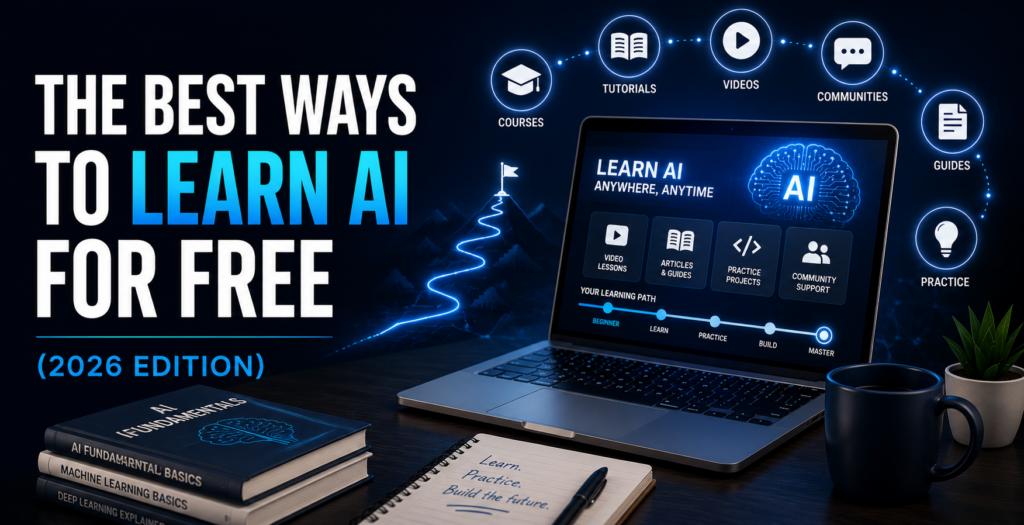
One of the biggest myths about artificial intelligence is that you need to spend hundreds—or even thousands—of dollars to learn it.
The truth is much simpler.
Some of the best AI education available today is completely free.
Whether you’re a student, small business owner, content creator, or simply curious about artificial intelligence, you can build a solid understanding of AI without paying for expensive courses or earning a computer science degree.
The key isn’t spending more money.
It’s knowing where to start.
In this guide, we’ll explore some of the best free ways to learn AI and build your skills step by step.
1. Use ChatGPT as Your Personal AI Tutor
One of the easiest ways to learn AI is by using AI itself.
Instead of reading long textbooks, you can ask questions like:
- What is Artificial Intelligence?
- Explain Machine Learning in simple terms.
- What is a neural network?
- How does ChatGPT work?
- What’s the difference between AI and AGI?
If you don’t understand an answer, simply ask:
Explain it like I’m 12 years old.
Or:
Give me a real-world example.
Learning becomes a conversation instead of a lecture.
2. Watch YouTube Tutorials
YouTube offers thousands of free AI videos for beginners.
Search for topics such as:
- Artificial Intelligence for Beginners
- ChatGPT Tutorials
- Prompt Engineering
- AI Productivity Tips
- AI Tools for Business
- AI Image Generation
Look for creators who explain concepts clearly and demonstrate real-world examples instead of focusing only on technical theory.
3. Read Beginner-Friendly AI Websites
Many websites publish free articles explaining AI concepts, tools, and tutorials.
Focus on learning topics like:
- What AI is
- How AI works
- AI terminology
- AI safety
- Practical AI use cases
Reading a little each day is often more effective than trying to learn everything at once.
4. Practice Every Day
The fastest way to learn AI is by using it.
Try asking AI to help with everyday tasks such as:
- Writing emails
- Planning meals
- Creating schedules
- Brainstorming ideas
- Learning new skills
- Explaining difficult concepts
The more you experiment, the more comfortable you’ll become.
5. Learn Prompt Writing
One of the most valuable AI skills isn’t coding.
It’s learning how to write effective prompts.
Practice asking AI in different ways.
Instead of saying:
Write an article.
Try:
Write a beginner-friendly article explaining Artificial Intelligence using simple language and real-world examples.
Small improvements in your prompts can dramatically improve your results.
6. Follow AI News
Artificial intelligence changes quickly.
Keeping up with major developments helps you understand how the technology is evolving.
You don’t need to follow every announcement.
Simply staying aware of major breakthroughs, new tools, and industry trends will help you build your knowledge over time.
7. Experiment With Different AI Tools
Don’t limit yourself to a single AI assistant.
Try different tools and compare their strengths.
For example:
- ChatGPT
- Claude
- Google Gemini
- Microsoft Copilot
- Perplexity
Each has its own personality, strengths, and features.
Using multiple tools helps you understand the broader AI landscape.
8. Join Online Communities
Learning becomes easier when you connect with other people.
Online communities often share:
- AI tips
- Prompt ideas
- Tutorials
- New tools
- Success stories
- Helpful discussions
Seeing how other people use AI can inspire new ideas for your own work.
9. Learn Through Real Projects
Rather than simply reading about AI, use it to complete actual projects.
For example:
- Create a weekly meal plan.
- Build a budget.
- Write a resume.
- Start a blog.
- Create a business plan.
- Design a logo.
- Generate YouTube ideas.
- Learn a new hobby.
Projects help turn knowledge into practical skills.
10. Stay Curious
Artificial intelligence evolves almost every month.
No one knows everything.
Even AI professionals continue learning.
The most successful learners aren’t the ones who memorize the most information.
They’re the ones who keep asking questions.
Curiosity is one of the greatest advantages you can have.
A Simple 30-Day AI Learning Plan
If you’re completely new to AI, here’s a simple roadmap.
Week 1
Learn the basics.
- What is AI?
- What is ChatGPT?
- What is Machine Learning?
- What are prompts?
Week 2
Practice using AI every day.
Try:
- Writing emails
- Summarizing articles
- Planning your schedule
- Brainstorming ideas
Week 3
Explore additional AI tools.
Compare:
- ChatGPT
- Claude
- Gemini
- Copilot
Notice what each one does well.
Week 4
Complete a personal project using AI.
Examples:
- Write a blog article.
- Build a business plan.
- Create a workout routine.
- Design social media content.
- Learn a completely new topic.
By the end of the month, you’ll have far more confidence than when you started.
Common Mistakes to Avoid
Many beginners accidentally slow their own progress.
Avoid these mistakes:
- Trying to learn everything at once.
- Buying expensive courses too early.
- Using AI without practicing.
- Expecting instant expertise.
- Giving up after a few mistakes.
Learning AI is a journey—not a race.
Frequently Asked Questions
Do I need to learn programming first?
No.
Most people can begin learning AI immediately using conversational AI tools without writing a single line of code.
Is YouTube enough to learn AI?
YouTube is an excellent starting point.
However, combining videos with hands-on practice and reading beginner-friendly articles creates a much stronger learning experience.
How long does it take to learn AI?
You can understand the basics within a few days.
Developing confidence and practical skills usually takes weeks or months of regular practice.
The learning never truly stops because AI continues evolving.
What’s the most important AI skill?
Learning how to ask good questions.
Writing better prompts often has a greater impact than learning technical jargon.
Final Thoughts
Learning artificial intelligence doesn’t have to be expensive, intimidating, or complicated.
In fact, some of the best AI education available today is completely free.
With curiosity, consistent practice, and the right resources, anyone can build practical AI skills that improve productivity, creativity, and problem-solving.
Start small.
Ask questions.
Experiment often.
Don’t worry about becoming an expert overnight.
Every conversation you have with an AI assistant teaches you something new.
The world of artificial intelligence is growing faster than ever, and there has never been a better time to begin learning.
The best part?
Your AI education can start today—and it doesn’t have to cost you a penny.