Being a student isn’t just about attending classes.
It’s about keeping up with assignments, preparing for exams, managing deadlines, taking notes, completing projects, and finding enough time to balance everything else in life.
It can feel overwhelming.
That’s one reason artificial intelligence has become such a valuable tool for students around the world.
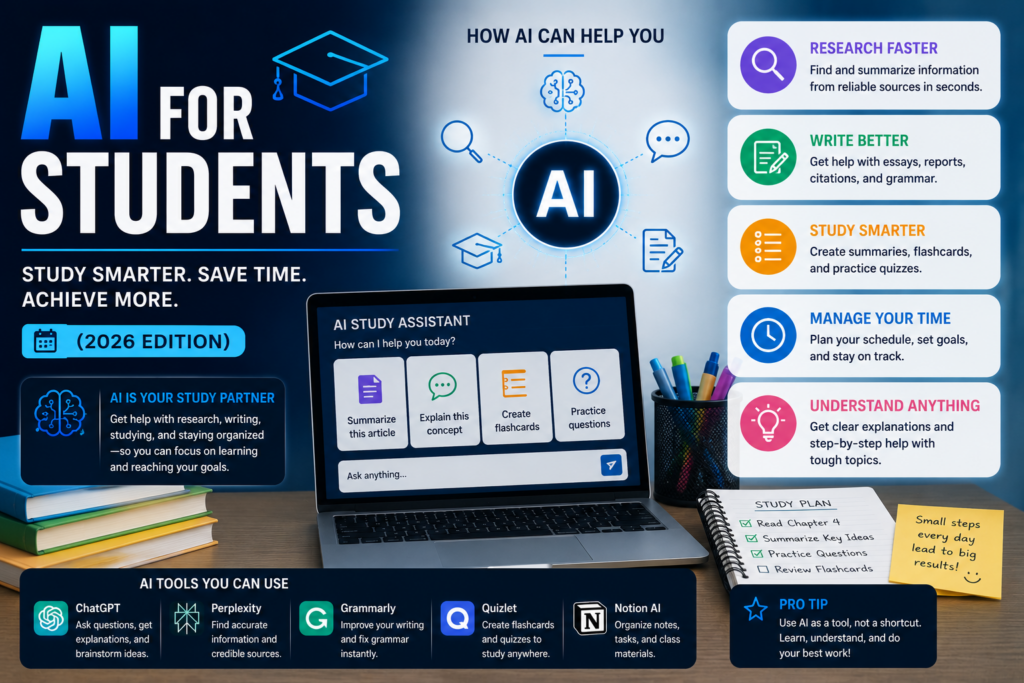
When used responsibly, AI can help you learn faster, stay organized, and spend less time on repetitive tasks—giving you more time to focus on understanding the material.
In this guide, we’ll explore practical ways students can use AI to improve their learning while avoiding common mistakes.
AI Is a Study Tool—Not a Shortcut
Before we begin, it’s important to understand one thing.
AI is designed to help you learn—not replace your learning.
Think of AI the same way you think about a calculator, a dictionary, or a search engine.
It’s a tool that can make studying easier, but it can’t replace the knowledge and critical thinking you’ll need in school and later in your career.
The goal isn’t to let AI do your work.
The goal is to help you do your best work.
1. Understand Difficult Topics
Every student eventually runs into a subject that just doesn’t make sense.
Instead of reading the same paragraph five times, ask AI questions like:
- “Explain photosynthesis in simple terms.”
- “How does compound interest work?”
- “What caused World War I?”
- “Teach me the basics of algebra.”
If the explanation is still confusing, ask AI to explain it differently.
One of AI’s biggest strengths is its ability to adapt explanations to your level of understanding.
2. Create Study Guides
Preparing for exams often means organizing a large amount of information.
AI can help you create:
- Chapter summaries
- Flashcards
- Vocabulary lists
- Practice questions
- Review sheets
- Study outlines
Having information organized in one place makes studying much more efficient.
3. Practice for Tests
Instead of simply rereading your notes, ask AI to quiz you.
For example:
- Create a 20-question biology quiz.
- Test me on world geography.
- Give me multiple-choice history questions.
- Ask me math problems one at a time.
Practicing retrieval is one of the best ways to strengthen long-term memory.
4. Improve Your Writing
Writing essays can be challenging, especially when you’re unsure how to begin.
AI can help you:
- Brainstorm ideas
- Build outlines
- Improve grammar
- Rewrite awkward sentences
- Check clarity
- Suggest stronger introductions
Remember, AI should help you improve your writing—not replace your own ideas.
Your teachers want to understand what you have learned.
5. Stay Organized
Students often juggle multiple classes, assignments, and deadlines.
AI can help create:
- Weekly study schedules
- Homework checklists
- Daily planners
- Project timelines
- Semester goals
Having a clear plan can reduce stress and help you stay on track.
6. Learn New Skills
School teaches many important subjects, but learning doesn’t stop when class ends.
AI can help you explore topics like:
- Coding
- Photography
- Public speaking
- Personal finance
- Graphic design
- Foreign languages
- Resume writing
- Interview preparation
Curiosity is one of the greatest advantages a student can have.
7. Break Large Projects Into Smaller Steps
Big assignments can feel intimidating.
AI can help divide them into manageable pieces.
For example, if you’re writing a research paper, AI can help you create a step-by-step plan that includes:
- Choosing a topic
- Finding reliable sources
- Building an outline
- Writing a first draft
- Editing and proofreading
Breaking a project into smaller tasks makes it much easier to get started.
8. Learn More Efficiently
Everyone learns differently.
Some students understand concepts better through examples.
Others prefer summaries or step-by-step explanations.
AI can adapt to your learning style.
You might ask:
- “Explain this with a real-world example.”
- “Teach me like I’m in middle school.”
- “Give me a visual analogy.”
- “Summarize this in five bullet points.”
Learning becomes more effective when information is presented in a way that makes sense to you.
Use AI Responsibly
AI is a powerful learning tool, but it should never replace your own work.
For example, it’s perfectly reasonable to ask AI to:
- Explain a concept
- Help you study
- Improve grammar
- Suggest ideas
- Create practice quizzes
However, submitting AI-generated assignments as your own when your school requires original work is dishonest and may violate your school’s academic integrity policies.
The best students use AI to understand more—not to learn less.
Common Mistakes Students Make
Relying on AI for Every Answer
Learning happens when you think through problems yourself.
Use AI to guide your learning, not replace it.
Accepting Information Without Checking It
AI can make mistakes.
Always verify important facts using your textbook, your teacher, or reliable sources.
Waiting Until the Last Minute
AI can help you plan ahead, but it can’t replace consistent study habits.
Start early whenever possible.
Forgetting to Ask Follow-Up Questions
If an explanation doesn’t make sense, ask AI to explain it another way.
Learning is a conversation, not a single answer.
Frequently Asked Questions
Can AI help me study?
Absolutely.
AI can explain concepts, create study guides, generate quizzes, and help organize information.
Is using AI considered cheating?
It depends on how it’s used.
Using AI to learn, practice, or improve your understanding is generally very different from submitting AI-generated work as your own when originality is required.
Always follow your school’s academic policies.
Can AI help improve my grades?
AI can be a valuable study partner, but your grades still depend on your effort, preparation, and understanding of the material.
Do I need to pay to use AI?
Not necessarily.
Many AI tools offer free versions that provide more than enough features for most students.
Final Thoughts
Artificial intelligence is changing the way students learn.
It can explain difficult topics, organize study materials, create practice quizzes, improve writing, and help you manage your time more effectively. When used responsibly, it becomes a powerful study partner that supports your learning instead of replacing it.
The most successful students won’t be the ones who ask AI to do all of their work. They’ll be the ones who use AI to ask better questions, deepen their understanding, and build stronger study habits.
Think of AI as a tutor that’s available whenever you need it—but remember that you’re still the one taking the test, writing the paper, and developing the skills that will stay with you long after graduation.
Use AI to become a better learner, not just a faster one. That’s the real advantage, and it’s a skill that will continue to benefit you long after your time in the classroom is over.