Teaching is one of the most rewarding professions—but it’s also one of the busiest.
Beyond the classroom, teachers spend countless hours preparing lessons, grading assignments, writing emails, creating quizzes, organizing materials, and helping students succeed.
Finding enough time for everything can be a challenge.
That’s where artificial intelligence can help.
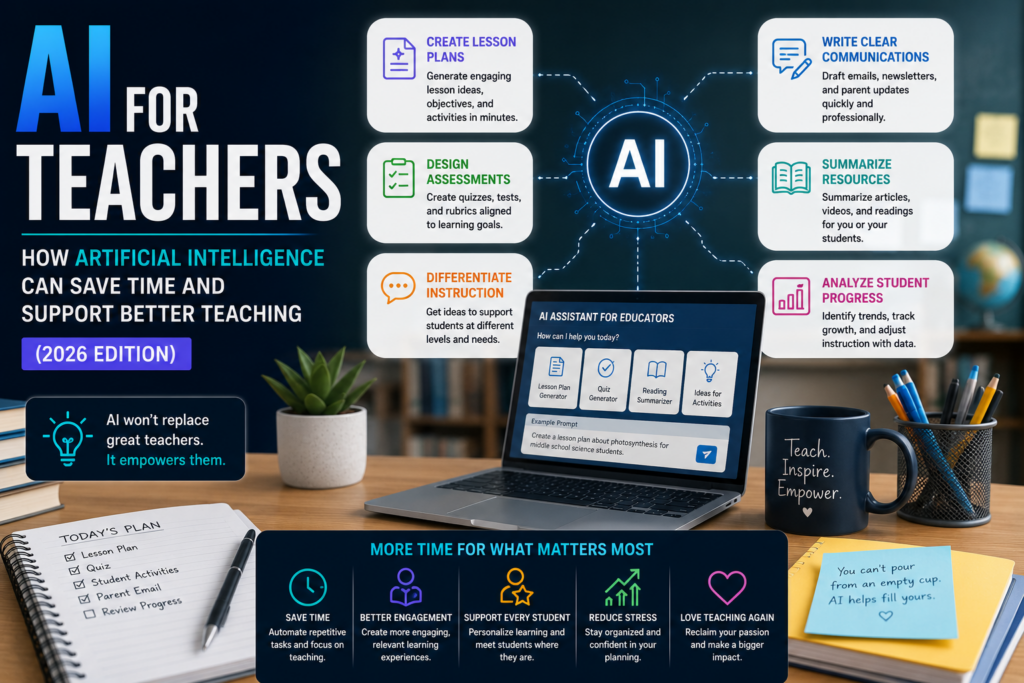
AI isn’t designed to replace teachers. Instead, it can assist with many of the routine tasks that consume valuable time, allowing educators to focus on what matters most: teaching, mentoring, and connecting with students.
In this guide, we’ll explore practical ways teachers can use AI to improve efficiency while maintaining the human connection that great education depends on.
AI Is a Teaching Assistant—Not a Replacement
Before exploring specific examples, it’s important to understand what AI does best.
AI can:
- Organize information
- Generate ideas
- Draft content
- Summarize text
- Create practice materials
- Save time on repetitive tasks
What it cannot replace is a teacher’s ability to:
- Build relationships
- Inspire students
- Understand classroom dynamics
- Encourage critical thinking
- Recognize emotional needs
- Adapt lessons based on real-time feedback
Technology can support education, but great teaching will always require human judgment and compassion.
1. Create Lesson Plans More Quickly
Planning engaging lessons takes time.
AI can help generate:
- Lesson outlines
- Classroom activities
- Learning objectives
- Discussion questions
- Homework ideas
- Extension activities
These drafts can serve as starting points, allowing teachers to customize lessons for their students and curriculum.
2. Develop Classroom Quizzes
Creating assessments from scratch isn’t always necessary.
AI can help generate:
- Multiple-choice quizzes
- Short-answer questions
- Vocabulary reviews
- Practice worksheets
- Exit tickets
- Review games
Teachers can then review and adjust the questions to match their learning goals.
3. Explain Difficult Concepts in Different Ways
Every classroom includes students who learn differently.
If one explanation doesn’t connect, AI can suggest another.
For example, you might ask AI to:
- Explain fractions using real-world examples.
- Describe photosynthesis for fifth-grade students.
- Teach the water cycle through storytelling.
- Compare historical events using simple language.
Having multiple ways to explain a concept can help reach a wider range of learners.
4. Draft Parent Communications
Keeping families informed is an important part of teaching.
AI can help draft:
- Classroom newsletters
- Parent emails
- Progress updates
- Event reminders
- Field trip announcements
- Conference invitations
Teachers can personalize these drafts before sending them.
5. Create Classroom Resources
Need fresh materials?
AI can help create:
- Vocabulary lists
- Study guides
- Reading questions
- Writing prompts
- Project ideas
- Classroom discussion topics
Instead of starting with a blank page, teachers can begin with a solid first draft.
6. Brainstorm Creative Activities
Sometimes students need something different to stay engaged.
AI can suggest:
- Icebreakers
- Group activities
- Classroom games
- STEM challenges
- Debate topics
- Writing exercises
- Hands-on learning ideas
These suggestions can inspire lessons that encourage participation and curiosity.
7. Organize Classroom Planning
Teachers manage many responsibilities at once.
AI can help organize:
- Weekly lesson schedules
- Unit plans
- Project timelines
- Classroom calendars
- To-do lists
- Professional development goals
Staying organized can reduce stress and free up more time for students.
8. Support Professional Growth
Teachers are lifelong learners.
AI can help explain topics such as:
- Classroom management strategies
- Educational technology
- New teaching methods
- Curriculum planning
- Differentiated instruction
- Student engagement techniques
It can also summarize educational articles or help organize professional learning notes.
Use AI Responsibly in Education
AI should support teaching—not replace thoughtful instruction.
Always:
- Review AI-generated content for accuracy.
- Ensure lessons align with curriculum standards.
- Adapt materials to meet your students’ needs.
- Protect student privacy when using AI tools.
Remember, AI doesn’t know your students the way you do.
Your professional judgment is essential.
Protect Student Privacy
When using AI, avoid entering confidential student information such as:
- Full names
- Grades
- Medical information
- Individual education plans (IEPs)
- Behavioral records
- Personal contact information
If you’re using AI to create classroom materials, keep student data anonymous unless you’re using an approved platform that complies with your school’s privacy requirements.
Protecting student information should always remain a top priority.
Common Misconceptions
“AI will replace teachers.”
No.
Teaching is built on relationships, communication, empathy, and adaptability—qualities AI cannot replace.
“Using AI makes teaching less personal.”
Not if it’s used thoughtfully.
By saving time on administrative work, AI can actually give teachers more opportunities to connect with students.
“AI always creates perfect lesson plans.”
Not always.
AI-generated content should always be reviewed and adjusted to match classroom goals and student needs.
“Only technology teachers need AI.”
AI can support educators across nearly every subject, including mathematics, science, history, language arts, music, physical education, and the arts.
Frequently Asked Questions
Can AI help reduce teacher workload?
Yes.
Many teachers use AI to speed up lesson planning, draft communications, generate classroom resources, and organize administrative tasks.
Is it okay to use AI in the classroom?
Many schools are exploring responsible ways to use AI. Be sure to follow your school’s policies and use AI as a tool to support learning rather than replace it.
Can AI grade assignments?
Some AI tools can assist with grading objective questions or provide feedback on writing, but teachers should continue reviewing student work and making final evaluations.
Should students know when AI was used to create classroom materials?
Transparency is often a good practice. If AI helped create or organize materials, teachers can decide how best to communicate that based on school policies and classroom expectations.
Final Thoughts
Artificial intelligence is giving teachers new ways to save time, generate ideas, and simplify everyday tasks.
From creating lesson plans and quizzes to organizing classroom resources and improving communication, AI can reduce many of the repetitive responsibilities that come with teaching.
The most important thing to remember is that AI supports great teaching—it doesn’t replace it.
Students still need encouragement, patience, creativity, and meaningful relationships. Those qualities come from educators, not algorithms.
When used responsibly, AI can help teachers spend less time on paperwork and more time doing what inspired them to enter the profession in the first place: helping students learn, grow, and succeed.
As education continues to evolve, teachers who understand how to use AI thoughtfully will be well positioned to create engaging learning experiences while making the most of their valuable time.