Artificial intelligence is changing the way people work.
Businesses are using AI to write reports, answer customer questions, analyze data, create marketing content, and automate repetitive tasks. As these tools become more capable, many workers are asking an important question:
“Will AI replace my job?”
It’s a reasonable concern.
Every major technological advancement—from the Industrial Revolution to the internet—has changed the workplace. Artificial intelligence is no different.
The good news is that the answer isn’t as simple as “yes” or “no.”
In most cases, AI isn’t replacing entire jobs. Instead, it’s changing how those jobs are performed.
Let’s take a closer look.
The Short Answer
Can AI replace some jobs?
Yes.
Can AI replace every job?
No.
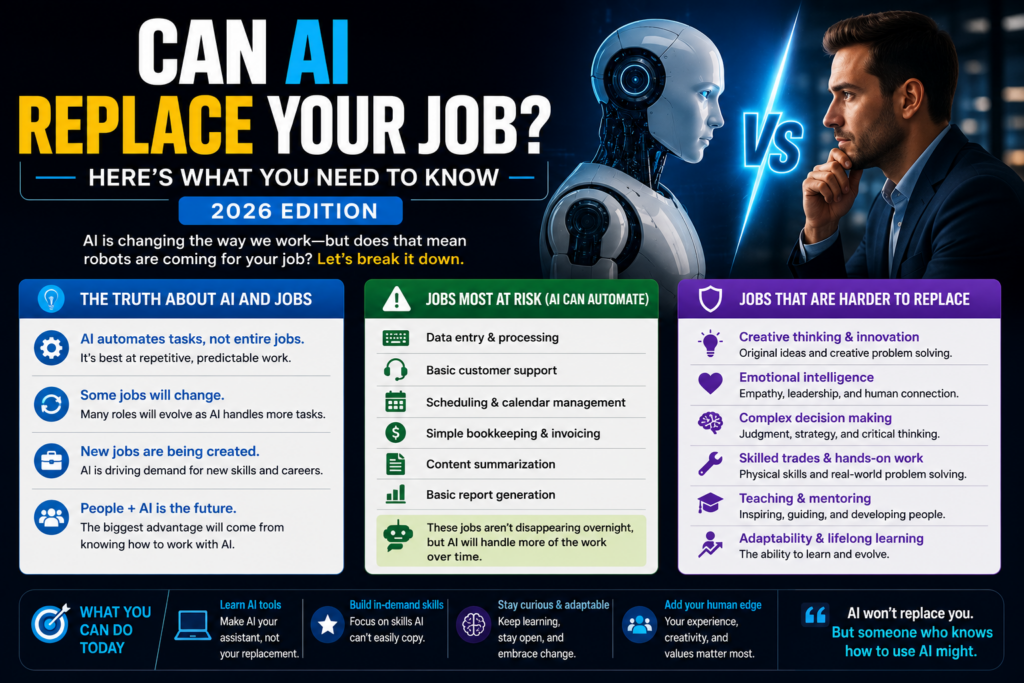
Most jobs involve a combination of different tasks. AI is very good at some of those tasks, but much less capable when it comes to others.
That’s why many experts believe AI is more likely to change jobs than eliminate them altogether.
What AI Does Well
Artificial intelligence is especially effective at handling tasks that are:
- Repetitive
- Time-consuming
- Based on patterns
- Data-driven
- Highly structured
For example, AI can:
- Draft emails
- Summarize documents
- Organize information
- Analyze spreadsheets
- Translate languages
- Answer common customer questions
- Generate reports
- Schedule appointments
These tasks can often be completed faster with AI than by a person working alone.
What AI Still Struggles With
Despite its impressive abilities, AI has important limitations.
It cannot truly replace qualities such as:
- Human empathy
- Emotional intelligence
- Leadership
- Creativity driven by personal experience
- Ethical decision-making
- Complex problem-solving in unpredictable situations
- Building trust and relationships
Many careers depend on these skills every day.
Jobs That May Change the Most
AI is likely to have the greatest impact on jobs that involve repetitive digital work.
Examples include:
- Data entry
- Basic customer support
- Administrative tasks
- Routine bookkeeping
- Simple content creation
- Scheduling and calendar management
In many cases, AI won’t eliminate these roles completely. Instead, workers may spend less time on repetitive tasks and more time handling exceptions, solving problems, and working directly with people.
Jobs That Still Rely Heavily on Human Skills
Many careers involve judgment, communication, creativity, or hands-on work that AI cannot easily replace.
Examples include:
- Teachers
- Nurses
- Electricians
- Plumbers
- Therapists
- Social workers
- Managers
- Skilled trades
- Emergency responders
- Healthcare professionals
Even in these fields, AI is increasingly being used as a tool to improve efficiency rather than replace people.
AI Is Creating New Opportunities
Whenever technology changes the workplace, it often creates new types of jobs as well.
Artificial intelligence is already creating demand for people who can:
- Use AI effectively
- Review AI-generated content
- Train AI systems
- Develop AI software
- Manage AI projects
- Create AI-powered businesses
- Teach others how to use AI
Many careers that involve AI today didn’t exist just a few years ago.
The People Most Likely to Benefit
One of the biggest misconceptions is that AI is competing against people.
In many situations, the real comparison is this:
Someone using AI versus someone who isn’t.
Imagine two employees doing the same job.
One uses AI to:
- Draft emails
- Summarize meetings
- Organize projects
- Brainstorm ideas
- Create presentations
The other completes every task manually.
Over time, the employee who uses AI responsibly may finish work faster, produce more polished results, and have more time to focus on higher-value tasks.
That’s why learning to work with AI is becoming an increasingly valuable skill.
How to Future-Proof Your Career
No one can predict exactly how every job will change.
However, there are several smart steps you can take today.
Learn How to Use AI
You don’t need to become a programmer.
Simply understanding how to use AI tools effectively can give you a valuable advantage.
Keep Learning
Technology changes quickly.
People who continue learning throughout their careers are generally better prepared to adapt to new tools and new ways of working.
Strengthen Human Skills
Communication, leadership, creativity, teamwork, and critical thinking remain valuable regardless of technological changes.
These are skills AI cannot easily replicate.
View AI as a Tool
Rather than fearing AI, ask yourself:
“How can this help me do my job better?”
That mindset often leads to new opportunities.
Common Misconceptions
“AI will replace everyone.”
No.
Some jobs will change significantly, while others may change very little.
“Learning AI is only for technology workers.”
Not at all.
Teachers, accountants, healthcare professionals, marketers, business owners, writers, and many others are already benefiting from AI.
“If AI can do one task, my entire job will disappear.”
Most jobs involve dozens of different responsibilities.
Automating one task doesn’t automatically eliminate the entire role.
“It’s too late to learn AI.”
Not even close.
Millions of people are just beginning to learn how AI works.
There’s still plenty of time to build useful skills.
Frequently Asked Questions
Which jobs are safest from AI?
Jobs that rely heavily on human interaction, complex decision-making, creativity, leadership, and hands-on physical work are generally more difficult to automate completely.
Should I be worried?
It’s natural to have concerns, but learning how AI works is usually a more productive response than fearing it.
Knowledge helps you adapt.
Do I need to learn programming?
No.
Many AI tools are designed for everyday users and require no coding experience.
Will AI continue changing the workplace?
Yes.
AI is evolving rapidly, and many industries will continue finding new ways to use it.
The key is staying curious and willing to learn.
Final Thoughts
Artificial intelligence is changing the workplace, but it isn’t rewriting the rules overnight.
Some routine tasks will become automated. Some jobs will evolve. New roles will emerge. Throughout history, technology has consistently changed how people work, and AI is the latest chapter in that story.
The people who are likely to thrive won’t necessarily be those with the most technical knowledge. They’ll be the ones who are willing to learn, adapt, and use AI as a tool to improve their work.
Instead of asking, “Will AI replace me?” a better question might be:
“How can AI help me become even better at what I already do?”
That shift in perspective changes AI from something to fear into something you can use to grow your skills, increase your productivity, and prepare for the future with confidence.
At MasterAIBasics, we believe the future belongs to people who understand AI—not because AI replaces them, but because they know how to work alongside it.