
Every major scientific field has a defining moment.
For aviation, it was the Wright brothers’ first successful flight.
For the internet, it was the development of interconnected computer networks.
For artificial intelligence, that defining moment took place during the summer of 1956 at a small college in New Hampshire.
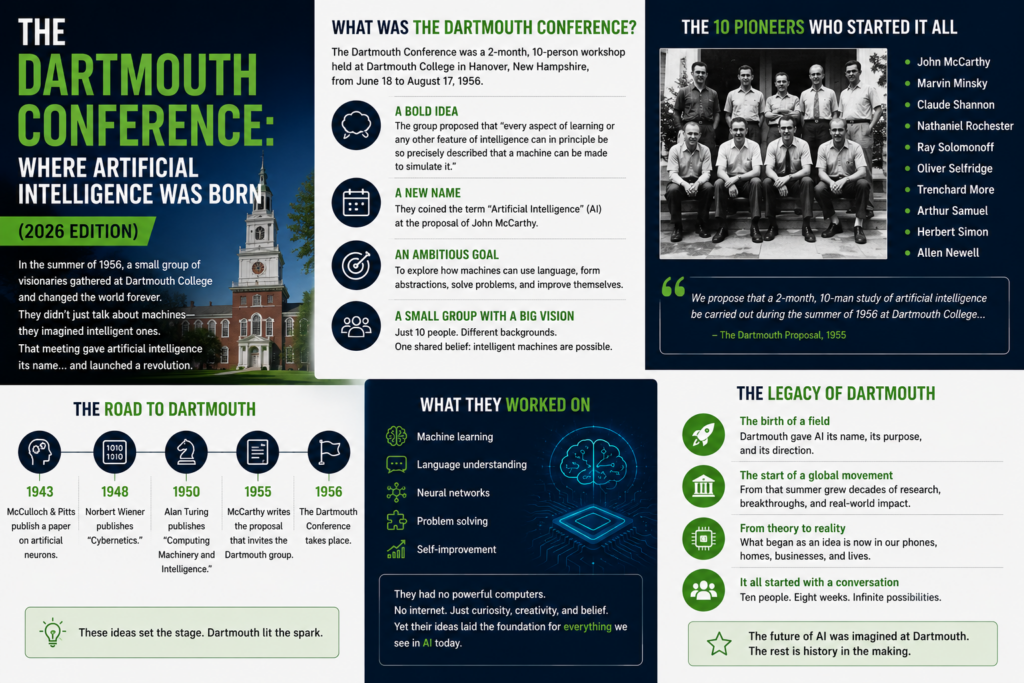
Known as the Dartmouth Summer Research Project on Artificial Intelligence, this gathering officially introduced the world to a new scientific discipline that would eventually transform nearly every industry on Earth.
Although only a small group of researchers attended, the ideas discussed during that summer continue to influence artificial intelligence today.
Many historians consider the Dartmouth Conference to be the birthplace of modern AI.
A World Before Artificial Intelligence
In the early 1950s, computers were nothing like the devices we use today.
They were enormous machines that filled entire rooms.
They were expensive.
They were slow by modern standards.
Most importantly, they were designed primarily to perform calculations—not to think, learn, or solve problems the way humans do.
Despite these limitations, several researchers believed computers could eventually do much more.
They imagined machines that could:
- Solve complex problems
- Learn from experience
- Understand language
- Make decisions
- Play games
- Mimic certain aspects of human intelligence
At the time, these ideas sounded almost unbelievable.
The Proposal That Started Everything
In 1955, computer scientist John McCarthy, along with Marvin Minsky, Nathaniel Rochester, and Claude Shannon, proposed holding a summer workshop to explore one ambitious question:
Could machines be made to simulate human intelligence?
To describe this new area of research, McCarthy introduced a simple but powerful name:
Artificial Intelligence.
That proposal led to a research workshop at Dartmouth College in Hanover, New Hampshire during the summer of 1956.
No one knew it at the time, but this meeting would become one of the most influential events in the history of technology.
The Researchers Who Gathered at Dartmouth
The conference brought together some of the brightest minds in mathematics, engineering, psychology, and computer science.
Among the participants were pioneers who would shape AI research for decades.
Some of the best-known attendees included:
- John McCarthy
- Marvin Minsky
- Claude Shannon
- Allen Newell
- Herbert A. Simon
- Nathaniel Rochester
Although each researcher had different ideas, they shared one remarkable belief:
Intelligence wasn’t magical.
If human thinking followed patterns and rules, perhaps machines could eventually learn those patterns too.
That simple idea became the foundation of artificial intelligence research.
The Big Questions
The researchers weren’t trying to build chatbots or image generators.
Instead, they focused on much deeper questions.
Could computers:
- Learn from experience?
- Solve problems without being told every step?
- Understand human language?
- Improve over time?
- Reason logically?
- Make decisions?
Today these questions may sound familiar.
Modern AI researchers are still exploring many of them.
Why the Conference Was So Important
Interestingly, the Dartmouth Conference didn’t produce an immediate technological breakthrough.
No revolutionary AI system was demonstrated.
No intelligent robot walked across the room.
Instead, something equally important happened.
The conference gave researchers:
- A shared vision
- A common vocabulary
- A scientific identity
- A long-term research agenda
For the first time, scientists around the world had a name for this exciting new field:
Artificial Intelligence.
That single phrase helped unite researchers from many different disciplines.
The Optimism of the 1950s
The participants were incredibly optimistic.
Some believed machines capable of human-level intelligence might be developed within just a few decades.
Looking back, those predictions proved far too optimistic.
Researchers underestimated how difficult intelligence actually is.
Understanding language…
Recognizing images…
Learning from experience…
Making common-sense decisions…
These turned out to be much harder problems than anyone expected.
The Road Wasn’t Easy
Following the Dartmouth Conference, governments and universities invested heavily in AI research.
Early successes created excitement.
But progress eventually slowed.
Computers lacked the processing power and memory needed to solve many of the problems researchers hoped to tackle.
This led to periods known as AI Winters, when funding declined and public enthusiasm faded.
Even so, the ideas introduced at Dartmouth never disappeared.
Researchers continued building upon them year after year.
How Dartmouth Shaped Modern AI
Although today’s AI systems are dramatically more powerful than researchers imagined in 1956, many of the conference’s original goals remain surprisingly familiar.
Modern AI can:
- Answer questions
- Translate languages
- Recognize images
- Play complex games
- Generate music
- Write computer code
- Hold conversations
- Assist with research
While today’s technology is far more advanced, it continues pursuing the same dream discussed during that summer at Dartmouth College.
The Lasting Legacy
More than half a century later, the Dartmouth Conference is remembered as one of the most important gatherings in computer science history.
Its influence extends far beyond universities.
Nearly every major AI breakthrough—from recommendation systems and virtual assistants to self-driving cars and generative AI—can trace part of its history back to the ideas shared during those meetings.
Without Dartmouth, Artificial Intelligence might still have developed.
But the conference gave the field direction, identity, and momentum that continues to shape AI research today.
Frequently Asked Questions
What was the Dartmouth Conference?
The Dartmouth Conference, officially called the Dartmouth Summer Research Project on Artificial Intelligence, was a research workshop held during the summer of 1956 that is widely considered the birth of Artificial Intelligence as a scientific field.
Why is the Dartmouth Conference important?
It officially introduced the term Artificial Intelligence, brought together leading researchers, and established AI as its own area of scientific study.
Who organized the Dartmouth Conference?
The conference proposal was organized primarily by John McCarthy, along with Marvin Minsky, Nathaniel Rochester, and Claude Shannon.
Did the conference create modern AI?
Not directly.
Instead, it established the vision and research direction that inspired decades of discoveries leading to today’s AI technologies.
Final Thoughts
History is often shaped by moments that seem ordinary at the time.
The Dartmouth Conference was one of those moments.
A small group of researchers gathered in the summer of 1956 to discuss a bold idea: that machines might one day perform tasks requiring human intelligence.
They couldn’t have imagined smartphones, AI assistants, self-driving cars, or tools capable of writing articles and generating artwork.
Yet their questions, ambitions, and optimism laid the foundation for everything that followed.
Today, artificial intelligence is transforming the way we work, learn, communicate, and create.
That journey didn’t begin with a viral chatbot or a breakthrough app.
It began in a classroom at Dartmouth College, where a handful of curious researchers dared to imagine a future that the rest of the world had not yet seen.
More than seventy years later, we’re still exploring the future they envisioned—and in many ways, we’re only getting started.