Artificial intelligence seems to be everywhere.
People use it to write emails, create artwork, answer questions, edit videos, and even help run businesses. With so much excitement surrounding AI, it’s easy to wonder:
“What can AI actually do?”
The short answer is: quite a lot.
But AI isn’t magic, and it can’t do everything.
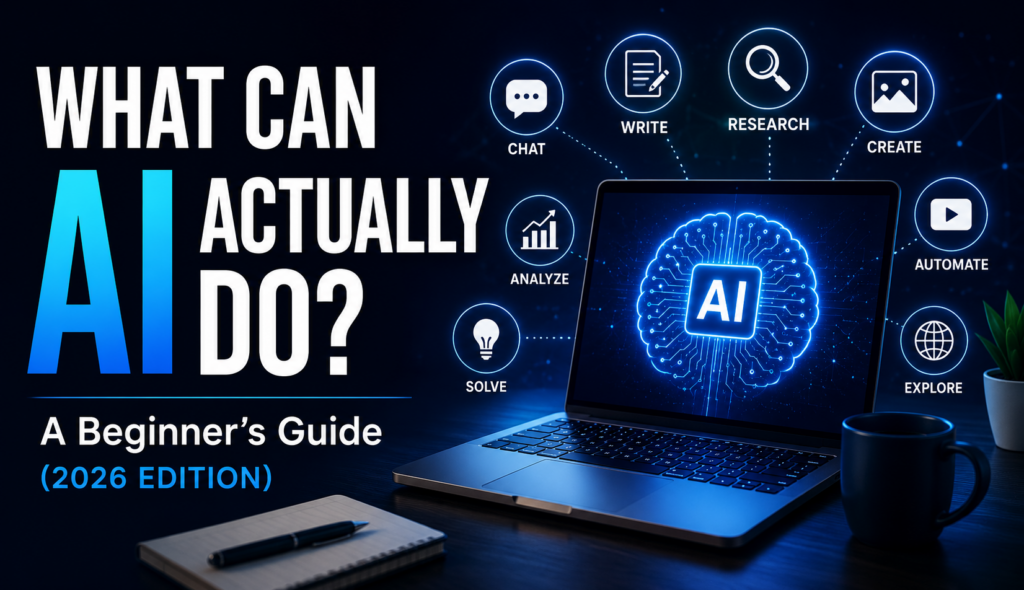
In this guide, we’ll explore what AI is capable of today, where it shines, where it struggles, and how millions of people are already using it in their daily lives.
AI Is a Tool, Not a Person
Before we talk about what AI can do, it’s important to understand one thing.
AI is a tool.
It doesn’t have emotions, opinions, dreams, or personal experiences. It doesn’t “know” things the way humans do.
Instead, AI analyzes information, recognizes patterns, and generates responses based on what it has learned.
Think of AI as a very capable assistant. It can help you complete tasks faster, organize information, generate ideas, and automate repetitive work—but it still relies on human guidance and judgment.
AI Can Answer Questions
One of AI’s most popular uses is answering questions.
You can ask AI about almost any topic, including:
- History
- Science
- Cooking
- Personal finance
- Travel
- Sports
- Technology
- Gardening
- Photography
You can even ask AI to explain complex subjects in simple language.
For example:
- “Explain inflation like I’m 12 years old.”
- “How does a solar eclipse happen?”
- “What’s the difference between a checking account and a savings account?”
Instead of reading through several websites, AI can provide a clear, conversational explanation in seconds.
AI Can Help You Write
Writing is one of AI’s greatest strengths.
Whether you’re staring at a blank page or polishing a final draft, AI can make the process much easier.
It can help you write:
- Emails
- Letters
- Resumes
- Cover letters
- Blog articles
- Social media posts
- Product descriptions
- Speeches
- Meeting agendas
- Thank-you notes
AI can also rewrite text to make it more professional, friendlier, shorter, longer, or easier to understand.
AI Can Help You Learn
Many people use AI as a personal tutor.
Instead of simply giving answers, AI can explain concepts, break problems into smaller steps, and adjust its explanations based on your level of knowledge.
For example, you can ask:
- “Teach me the basics of investing.”
- “Help me understand algebra.”
- “Quiz me on world geography.”
- “Explain photosynthesis in simple terms.”
If something doesn’t make sense, you can ask follow-up questions until it does.
AI Can Help You Stay Organized
AI is excellent at organizing information.
It can create:
- To-do lists
- Weekly schedules
- Travel itineraries
- Grocery lists
- Meal plans
- Study schedules
- Cleaning checklists
- Project timelines
Instead of spending time planning everything yourself, AI can give you a strong starting point that you can customize.
AI Can Brainstorm Ideas
Sometimes the hardest part of a project is getting started.
AI can help generate ideas for:
- Business names
- YouTube channels
- Blog topics
- Marketing campaigns
- Birthday parties
- Vacation destinations
- Gift ideas
- Classroom activities
Even if you don’t use its first suggestion, AI can help spark your own creativity.
AI Can Create Images
Modern AI can generate original images from written descriptions.
For example, you might ask for:
- A futuristic city skyline
- A watercolor painting of a mountain lake
- A company logo concept
- A birthday invitation
- A fantasy landscape
Artists, designers, educators, and marketers use AI-generated images to speed up creative work and explore new ideas.
AI Can Help Create Videos
Video creators are increasingly using AI to save time.
AI can assist with:
- Writing video scripts
- Generating captions
- Editing footage
- Removing background noise
- Creating voiceovers
- Suggesting titles
- Writing video descriptions
While AI doesn’t replace creativity, it can handle many repetitive editing tasks.
AI Can Generate Music and Voices
AI is no longer limited to text.
Today, it can create:
- Original songs
- Instrumental music
- Voice narration
- Audiobooks
- Podcast intros
- Sound effects
Content creators often use AI to produce audio quickly and professionally.
AI Can Help Businesses
Businesses of all sizes are finding practical uses for AI.
Common examples include:
- Answering customer questions
- Writing marketing copy
- Organizing data
- Scheduling appointments
- Summarizing meetings
- Creating reports
- Managing projects
- Analyzing trends
By automating repetitive tasks, AI allows employees to focus on more valuable work.
AI Can Help With Everyday Life
You don’t have to own a business to benefit from AI.
Many people use it every day for simple tasks like:
- Planning vacations
- Finding recipes
- Creating shopping lists
- Preparing for interviews
- Learning hobbies
- Comparing products
- Building workout routines
- Managing personal budgets
Small time savings can add up quickly.
What AI Can’t Do Well
Although AI is powerful, it still has limitations.
AI may:
- Misunderstand unclear questions
- Give incorrect information
- Miss important context
- Struggle with highly emotional situations
- Produce outdated answers if current information isn’t available
That’s why you should always review AI-generated content before relying on it for important decisions.
Think of AI as a helpful first draft—not the final authority.
Common Misconceptions
“AI can replace every job.”
Not likely.
AI is changing how many jobs are performed, but in most cases it’s becoming a tool that helps people work more efficiently rather than replacing them entirely.
“AI is only useful for technology experts.”
Not at all.
Some of the most enthusiastic AI users are teachers, students, parents, healthcare workers, small business owners, and retirees.
“AI always tells the truth.”
No.
AI can make mistakes. That’s why it’s important to verify important facts using trusted sources.
Frequently Asked Questions
Can AI think like a human?
No.
AI can generate impressive responses, but it doesn’t think, feel, or understand the world the way people do.
Can AI create original ideas?
AI can combine information in creative ways and generate new content, but human creativity, experience, and judgment remain essential.
Is AI difficult to use?
Not anymore.
Most modern AI tools are designed for everyday users and require little or no technical knowledge.
Will AI become even more capable?
Almost certainly.
AI technology continues to improve rapidly, with new features and applications being introduced every year.
Final Thoughts
Artificial intelligence is already changing the way people work, learn, create, and solve everyday problems.
From writing emails and organizing schedules to generating artwork and helping businesses operate more efficiently, AI has become one of the most versatile tools available today.
The key is understanding what AI does well—and where human judgment is still essential.
You don’t need to use every AI feature to benefit from it. Start with one task that takes up your time, such as writing, planning, or learning something new. As you become more comfortable, you’ll naturally discover additional ways AI can fit into your daily routine.
The future of AI isn’t about replacing people. It’s about giving people better tools to think, create, and accomplish more. Learning what AI can actually do is the first step toward using it with confidence.