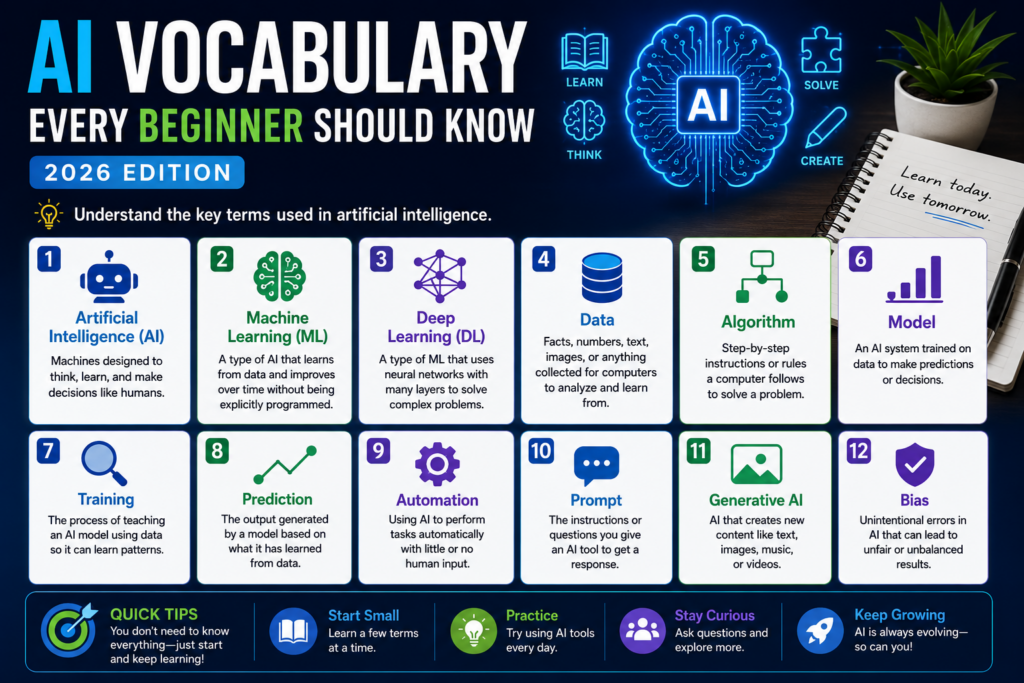
If you’re new to artificial intelligence, you’ve probably noticed that AI has a language of its own.
Terms like algorithm, prompt, machine learning, large language model, and hallucination appear everywhere. Technology websites use them. YouTube creators mention them. News articles assume you already know what they mean.
For many beginners, that’s where the confusion begins.
The good news is that you don’t need to become a computer scientist to understand artificial intelligence. Learning just a handful of common AI terms can make articles easier to read, videos easier to follow, and AI tools much easier to use.
That’s exactly why we created this glossary.
Instead of searching multiple websites every time you encounter an unfamiliar word, you’ll find many of the most common AI terms explained here in plain English. Each definition includes a simple explanation, a real-world example, and related terms to help you continue learning.
Whether you’re using AI for work, school, business, or simple curiosity, this guide will help you build a solid foundation.
Let’s start with some of the most important terms you’ll encounter.
Algorithm
Definition: A set of instructions that tells a computer how to complete a task.
In Plain English: Think of an algorithm like a recipe. A recipe tells you exactly how to bake a cake by following a series of steps. An algorithm works the same way. It tells a computer what to do, step by step, to solve a problem or complete a task. Every website, smartphone app, and AI tool uses algorithms behind the scenes.
Example: When Netflix recommends a movie based on what you’ve watched before, it’s using algorithms to decide what you might enjoy next.
Related Terms: Artificial Intelligence, Machine Learning
Artificial Intelligence (AI)
Definition: Technology that enables computers to perform tasks that normally require human intelligence.
In Plain English: Artificial Intelligence, often called AI, is the broad field of technology focused on building systems that can perform tasks such as answering questions, recognizing images, translating languages, writing text, solving problems, and making recommendations.
Think of AI as the largest category. Technologies like Machine Learning and Deep Learning are part of Artificial Intelligence.
Example: Asking an AI assistant to write an email, explain a difficult topic, or help plan a vacation.
Related Terms: Machine Learning, Deep Learning, Large Language Model (LLM)
Chatbot
Definition: A computer program designed to communicate with people through conversation.
In Plain English: Chatbots allow you to ask questions and receive answers using everyday language. Early chatbots could only answer simple questions. Today’s AI chatbots are much more advanced. They can write articles, summarize documents, explain difficult concepts, brainstorm ideas, and even help create computer code.
Not every chatbot uses artificial intelligence, but many modern chatbots are powered by advanced AI models.
Example: Using an AI assistant to help write your resume or answer questions about history.
Related Terms: AI Assistant, Prompt, Large Language Model (LLM)
Computer Vision
Definition: A branch of Artificial Intelligence that enables computers to recognize and understand images and videos.
In Plain English: Computer Vision gives computers the ability to “see.” Instead of simply looking at a picture, AI can identify people, objects, animals, text, vehicles, and even actions taking place inside an image or video.
Computer Vision powers many technologies we use every day without even realizing it.
Example: Your smartphone recognizing your face to unlock the screen is an example of Computer Vision.
Related Terms: Deep Learning, Neural Network
Context
Definition: The background information you provide that helps AI better understand your request.
In Plain English: Context gives AI additional details about what you’re trying to accomplish. The more useful context you provide, the more accurate and personalized the response is likely to be.
Many beginners ask very short questions and then wonder why the answer isn’t exactly what they wanted. Often, the missing ingredient is context.
Example:
Instead of asking:
“Write an email.”
You could ask:
“Write a professional email to my manager explaining that I’ll be arriving 30 minutes late because of a doctor’s appointment.”
The second prompt gives the AI enough context to provide a much better answer.
Related Terms: Prompt, Response
Dataset
Definition: A collection of information used to train or evaluate an AI system.
In Plain English: Before AI can recognize images, answer questions, or understand language, it must learn from large amounts of information. That information is organized into datasets.
Datasets may contain:
- Books
- Articles
- Images
- Videos
- Audio recordings
- Numbers
- Documents
- Scientific research
The quality of a dataset plays a major role in how well an AI system performs.
Example: To teach an AI system to recognize dogs, developers might train it using millions of labeled photographs of different dog breeds.
Related Terms: Training, Machine Learning
Deep Learning
Definition: A specialized type of Machine Learning that uses artificial neural networks to recognize complex patterns.
In Plain English: Deep Learning is one of the most advanced forms of AI available today. Instead of relying on simple rules, Deep Learning allows computers to learn from enormous amounts of data and recognize patterns that would be difficult for traditional computer programs to detect.
Deep Learning powers many of today’s most impressive AI technologies, including conversational AI, image generation, speech recognition, language translation, and self-driving vehicle research.
While the technical details are complex, beginners only need to remember one thing:
Deep Learning helps AI become much better at understanding language, recognizing images, and solving complicated problems.
Example: When an AI image generator creates a realistic picture from a written description, Deep Learning is doing much of the work behind the scenes.
Related Terms: Artificial Intelligence, Machine Learning, Neural Network
Fine-Tuning
Definition: The process of taking an existing AI model and training it further for a specific purpose.
In Plain English: Think of Fine-Tuning like hiring a new employee. They already have general knowledge, but before they can do a specific job, they need additional training.
AI works in a similar way.
A general AI model may understand language, writing, and reasoning. Through fine-tuning, developers can make it especially good at tasks like answering medical questions, assisting lawyers, helping customer support teams, or understanding financial documents.
Instead of building a brand-new AI model from scratch, developers improve an existing one for a specialized role.
Example: A hospital might use a fine-tuned AI model that has been trained to understand medical terminology and summarize patient records more effectively than a general-purpose AI assistant.
Related Terms: Model, Training, Machine Learning
Generative AI
Definition: Artificial Intelligence that creates new content instead of simply analyzing existing information.
In Plain English: Generative AI doesn’t just search for information—it creates something new.
Depending on the tool, it can generate:
- Articles
- Emails
- Images
- Music
- Videos
- Computer code
- Business ideas
- Marketing content
Most of today’s popular AI tools fall into this category because they’re designed to help people create rather than simply search.
Example: Asking an AI assistant to write a blog article or generate an original image from a written description.
Related Terms: Artificial Intelligence, Prompt, Large Language Model (LLM)
Hallucination
Definition: When an AI system confidently provides information that is incorrect, misleading, or completely made up.
In Plain English: One of the most important things beginners should understand is that AI can sometimes be wrong.
Instead of saying, “I don’t know,” AI may occasionally generate an answer that sounds convincing but isn’t accurate.
This is called a hallucination.
Hallucinations don’t happen because AI is trying to deceive you. They happen because AI predicts what the most likely answer should be based on patterns in data.
That’s why it’s always important to verify information involving:
- Health
- Legal matters
- Finances
- Academic research
- Safety
- Important business decisions
Example: An AI assistant invents the title of a book that doesn’t actually exist or attributes a quote to the wrong person.
Related Terms: Response, Large Language Model (LLM)
Large Language Model (LLM)
Definition: A type of AI model trained to understand and generate human language.
In Plain English: A Large Language Model, often shortened to LLM, is the technology behind many of today’s AI assistants.
It has learned from enormous amounts of text so it can:
- Answer questions
- Write articles
- Explain difficult topics
- Summarize information
- Translate languages
- Hold conversations
You don’t need to understand the mathematics behind an LLM to use one effectively.
Simply remember this:
The LLM is the “brain” that allows many AI assistants to understand your words and generate useful responses.
Example: Asking an AI assistant to explain the rules of baseball or help you write a professional email.
Related Terms: Artificial Intelligence, Prompt, Response
Machine Learning
Definition: A branch of Artificial Intelligence that allows computers to learn from data instead of following only fixed instructions.
In Plain English: Traditional computer programs follow rules written by programmers.
Machine Learning works differently.
Instead of programming every possible rule, developers provide large amounts of information. The AI studies that information, finds patterns, and gradually improves its ability to make predictions or recognize similar examples.
This ability to learn from data is what makes modern AI so powerful.
Example: Email services learning to recognize spam messages by analyzing millions of previous emails.
Related Terms: Artificial Intelligence, Deep Learning, Dataset
Model
Definition: A trained AI system that performs a specific task.
In Plain English: After an AI system has been trained, the finished product is called a model.
Think of it this way:
Training is the learning process.
The model is the result of that learning.
Different AI models are designed for different purposes. Some specialize in language, while others focus on images, speech, music, or scientific research.
Example: An AI model that can recognize handwritten numbers or answer questions in natural language.
Related Terms: Training, Fine-Tuning, Large Language Model (LLM)
Natural Language Processing (NLP)
Definition: A branch of Artificial Intelligence that helps computers understand, interpret, and generate human language.
In Plain English: Natural Language Processing—commonly called NLP—allows computers to understand the way people naturally speak and write.
Without NLP, computers would struggle to understand questions, recognize grammar, identify meaning, or respond conversationally.
Although many modern AI systems now rely on Large Language Models, you’ll still hear the term NLP used frequently because it represents the broader field of helping computers work with human language.
Example: AI translating English into Spanish or understanding that the words “car” and “automobile” refer to the same general idea.
Related Terms: Large Language Model (LLM), Prompt, Response
Neural Network
Definition: A computer system inspired by the way neurons in the human brain are connected.
In Plain English: Despite the name, a neural network is not an actual brain. It’s a mathematical system that helps AI recognize patterns and learn from large amounts of information.
Neural networks are especially good at identifying relationships that would be difficult for traditional computer programs to recognize. They play a major role in modern AI applications such as speech recognition, image generation, facial recognition, and language translation.
You don’t need to understand the mathematics behind neural networks to use AI effectively. Just remember that they’re one of the core technologies that make today’s advanced AI possible.
Example: An AI recognizing a cat in a photograph after learning from millions of images.
Related Terms: Deep Learning, Machine Learning, Computer Vision
Prompt
Definition: The instruction, request, or question you give to an AI system.
In Plain English: Every conversation with AI begins with a prompt.
Your prompt tells the AI what you want it to do. The clearer and more specific your prompt is, the more useful the response is likely to be.
Good prompts often include details about:
- Your goal
- The audience
- The desired format
- Any important context
Learning to write better prompts is one of the easiest ways to improve your results when using AI.
Example: “Write a friendly email thanking a customer for their purchase.”
Related Terms: Context, Response, Large Language Model (LLM)
Response
Definition: The answer or content generated by an AI after it receives a prompt.
In Plain English: A response is simply AI’s reply.
Depending on your prompt, the response might be:
- An answer
- An article
- An image
- A summary
- Computer code
- A checklist
- A table
- A business plan
If the response isn’t exactly what you wanted, don’t worry. One of AI’s biggest strengths is that you can continue the conversation by asking follow-up questions or requesting changes.
Example: Asking AI to create a weekly workout plan and receiving a detailed schedule.
Related Terms: Prompt, Context, Large Language Model (LLM)
Token
Definition: A small piece of text that an AI processes while reading and generating language.
In Plain English: AI doesn’t actually read text one letter or one sentence at a time.
Instead, it breaks language into smaller pieces called tokens.
A token may be:
- A whole word
- Part of a word
- A number
- Punctuation
Most people never need to think about tokens while using AI. However, you’ll often hear about them when discussing AI pricing, response limits, or how much information an AI model can remember during a conversation.
Example: A long article contains many more tokens than a short email.
Related Terms: Large Language Model (LLM), Prompt
Training
Definition: The process of teaching an AI model by exposing it to large amounts of information.
In Plain English: Before an AI model can answer questions or recognize patterns, it must first learn.
During training, developers expose AI to enormous collections of books, articles, images, videos, audio, and other information. The AI studies these examples and gradually becomes better at recognizing patterns and completing specific tasks.
Training can take weeks or even months, depending on the size and complexity of the model.
Example: Teaching an AI image recognition system by showing it millions of labeled photographs.
Related Terms: Dataset, Machine Learning, Model
Voice Recognition
Definition: Technology that allows computers to recognize and understand spoken language.
In Plain English: Voice Recognition enables AI to listen to what people say and convert spoken words into text or commands.
It’s used in many everyday devices and services, including smartphones, smart speakers, navigation systems, customer support systems, and accessibility tools.
Voice Recognition continues to improve as AI becomes better at understanding different accents, speaking styles, and background noise.
Example: Speaking to your phone to send a text message without touching the keyboard.
Related Terms: Natural Language Processing (NLP), Artificial Intelligence
Frequently Asked Questions
Do I need to memorize all of these terms?
No.
The goal isn’t memorization. As you continue using AI, these words will naturally become more familiar. Simply understanding the basic ideas is enough to build confidence.
Which AI term is the most important for beginners?
One of the most useful terms to understand is Prompt.
Every interaction with AI begins with a prompt, and learning how to write clear prompts will improve almost every conversation you have with an AI assistant.
Why do AI articles use so many technical terms?
Many AI articles are written for developers, engineers, or researchers.
At MasterAIBasics, our goal is different. We explain AI in plain English so anyone can understand it, regardless of their technical background.
Will new AI vocabulary continue to appear?
Absolutely.
Artificial intelligence is evolving rapidly. As new technologies emerge, new terms will become part of everyday conversations.
We’ll continue updating this glossary so it remains a valuable resource for beginners.
Congratulations! You Now Speak Basic AI.
If you’ve made it this far, congratulations—you’ve already learned many of the most common AI terms you’ll encounter as a beginner.
The next time you read an article about artificial intelligence, watch a YouTube video, or try a new AI tool, you’ll recognize many of the words that once seemed confusing.
More importantly, you’ll understand what they actually mean.
Don’t worry if you can’t remember every definition perfectly. Learning AI is like learning any new language. The more you read, practice, and experiment, the more familiar these terms will become.
Artificial intelligence is evolving quickly, and new vocabulary will continue to appear. That’s why we’ll continue updating this glossary as new technologies and concepts emerge.
Until then, you’ve already taken an important step.
You no longer have to wonder what people mean when they talk about prompts, machine learning, large language models, or neural networks.
You now speak the language of AI—and that’s a great foundation for everything you’ll learn next.
Thank you for making MasterAIBasics part of your AI learning journey.