Artificial intelligence is one of the most useful technologies ever created.
It can explain difficult concepts, write emails, summarize documents, generate ideas, and answer questions in seconds.
But there’s one important thing every AI user should understand:
AI can be wrong.
Most of the time, AI provides helpful and accurate information.
However, it can occasionally generate incorrect facts, misunderstand questions, or confidently state something that simply isn’t true.
These mistakes are commonly called AI hallucinations.
Understanding what AI hallucinations are—and knowing how to fact-check AI responses—is one of the most important skills you can develop.
Let’s learn how to use AI responsibly.
What Is an AI Hallucination?
An AI hallucination occurs when an AI generates information that sounds believable but is actually incorrect, misleading, or completely made up.
The AI isn’t trying to deceive you.
It simply predicts what response is most likely based on patterns in its training rather than verifying every statement as a human expert might.
Think of it like a student who sounds very confident during a presentation—but accidentally remembers several facts incorrectly.
The confidence doesn’t make the information accurate.
Why Do AI Hallucinations Happen?
AI doesn’t “know” facts the way people do.
Instead, it predicts words based on patterns learned from enormous amounts of information.
Because of that, AI may occasionally:
- Misremember facts
- Mix together different sources
- Invent names or dates
- Misinterpret your question
- Fill in missing information with incorrect guesses
Most of the time, these mistakes are minor.
Sometimes they can be significant.
Examples of AI Hallucinations
Here are a few examples.
Incorrect Historical Information
AI may provide the wrong date for a historical event.
Made-Up Sources
Sometimes AI may reference books, research papers, or websites that don’t actually exist.
Incorrect Statistics
AI might confidently provide percentages or numbers that are inaccurate or outdated.
Misunderstood Questions
If your prompt is unclear, AI may answer a different question than the one you intended to ask.
When Should You Fact-Check AI?
Not every conversation requires extensive verification.
However, you should always double-check AI responses involving:
- Medical advice
- Legal matters
- Financial decisions
- Taxes
- Scientific research
- Academic papers
- News
- Statistics
- Professional reports
The higher the stakes, the more important verification becomes.
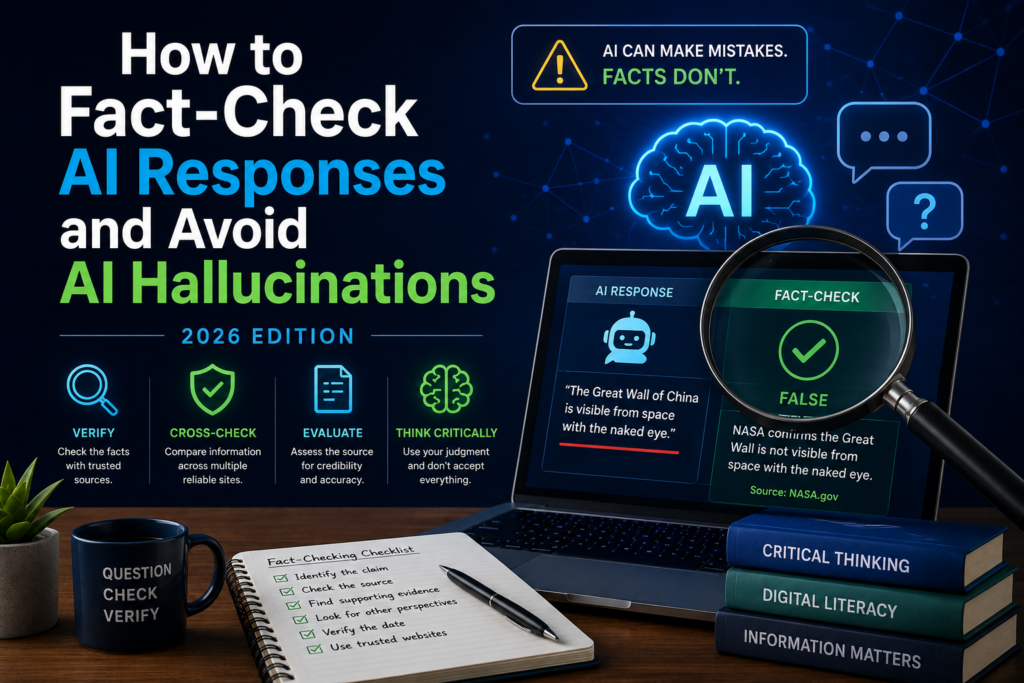
How to Fact-Check AI Responses
Fortunately, verifying AI-generated information is usually straightforward.
1. Ask AI for Its Sources
If an answer includes important factual claims, ask:
What sources support this information?
Or:
Where can I verify these facts?
This won’t guarantee the sources are correct, but it gives you a starting point for further research.
2. Compare Multiple Reliable Sources
Never rely on a single source for important information.
Compare AI responses with trusted resources such as:
- Government websites
- Universities
- Medical organizations
- Professional associations
- Peer-reviewed research
- Reputable news organizations
If multiple trustworthy sources agree, your confidence increases.
3. Ask Follow-Up Questions
Sometimes AI gives incomplete answers rather than incorrect ones.
Ask questions like:
- Can you explain that differently?
- Are there exceptions?
- What’s the evidence?
- Is this current information?
- How confident are you about this answer?
Additional context often improves the quality of the response.
4. Verify Dates and Numbers
Dates, statistics, and numerical information are among the easiest facts to verify.
If AI says:
The population is…
Or:
This happened in…
Take a moment to confirm the information using reliable sources.
5. Use Common Sense
If something sounds unbelievable, it deserves a second look.
Extraordinary claims require extra verification.
Trust your curiosity.
Better Prompts Can Reduce Mistakes
The way you ask your question can influence the quality of the answer.
Instead of asking:
Tell me about diabetes.
Try:
Explain Type 2 diabetes in simple language. Include common symptoms, but avoid giving medical advice.
Providing context often helps AI produce clearer and more accurate responses.
AI Is a Starting Point—Not the Final Word
One of the best ways to think about AI is as a research assistant.
It can:
- Explain concepts
- Organize information
- Suggest ideas
- Summarize articles
- Speed up research
But it shouldn’t replace expert advice or careful fact-checking when accuracy is essential.
Common Mistakes Beginners Make
Many new AI users accidentally:
- Assume AI is always correct.
- Skip fact-checking.
- Copy information without reviewing it.
- Ignore outdated information.
- Trust made-up citations.
Avoiding these habits will make you a much more effective AI user.
Tips for Responsible AI Use
Here are a few habits that experienced AI users follow:
- Verify important facts.
- Ask follow-up questions.
- Compare multiple reliable sources.
- Read AI responses critically.
- Keep learning.
The goal isn’t to distrust AI.
The goal is to use it wisely.
Frequently Asked Questions
What is an AI hallucination?
An AI hallucination is an incorrect or fabricated response generated by an AI system that may sound convincing even though it’s inaccurate.
Does ChatGPT hallucinate?
Like other AI assistants, ChatGPT can occasionally generate incorrect information.
That’s why it’s important to verify important facts before relying on them.
Should I trust AI for medical or legal advice?
AI can provide general educational information, but it should not replace qualified medical, legal, or financial professionals.
Always consult appropriate experts for decisions involving your health, finances, or legal rights.
What’s the best way to avoid AI hallucinations?
Use clear prompts, ask follow-up questions, verify important information using reliable sources, and treat AI as a helpful assistant rather than an unquestionable authority.
Final Thoughts
Artificial intelligence is one of the most powerful learning and productivity tools ever created.
It can save time, explain difficult concepts, generate ideas, and help solve problems faster than ever before.
But with that power comes responsibility.
Learning how to fact-check AI responses is just as important as learning how to write good prompts.
The most successful AI users aren’t the ones who believe every answer they receive.
They’re the ones who know when to ask another question, verify a fact, or consult a trusted source.
Think of AI as an incredibly knowledgeable assistant—one that works quickly, offers valuable insights, and helps you think more efficiently.
Just remember that even the best assistant can make mistakes.
By combining AI’s speed with your own critical thinking and careful verification, you’ll make better decisions, avoid costly errors, and get the very best from this remarkable technology.
In the world of AI, curiosity and healthy skepticism are two of your greatest strengths.