Introduction
Artificial intelligence is evolving rapidly, and one of the newest terms you’ll hear is AI agent. While chatbots like ChatGPT answer questions and generate content, AI agents take things a step further by completing tasks on your behalf.
But what exactly is an AI agent, and why are so many technology companies investing in them?
In this beginner-friendly guide, you’ll learn what AI agents are, how they work, how they’re different from chatbots, real-world examples, their benefits, limitations, and why many experts believe they represent the next major step in artificial intelligence.
What Is an AI Agent?
An AI agent is an artificial intelligence system that can understand a goal, make decisions, and take actions to help accomplish that goal.
Unlike a traditional chatbot that simply responds to your questions, an AI agent can often perform multiple steps to complete a task with little or no additional input.
Think of it as having a digital assistant that doesn’t just answer questions—it actually helps get things done.
A Simple Example
Imagine you tell a chatbot:
“Find me the cheapest flight to Miami.”
The chatbot might provide suggestions or links.
Now imagine telling an AI agent:
“Book me the cheapest nonstop flight to Miami next Friday, reserve a hotel near the beach, and add everything to my calendar.”
The AI agent could complete each step automatically, provided it has permission to access those services.
That’s what makes AI agents different.
How Do AI Agents Work?
AI agents combine several AI technologies to complete tasks.
Typically, they can:
- Understand your request
- Break large tasks into smaller steps
- Search for information
- Make decisions
- Use software tools
- Learn from previous interactions
- Complete the task
- Report the results back to you
Instead of waiting for instructions after every step, an AI agent works toward achieving your overall goal.
AI Agent vs. Chatbot
Although the two are similar, they are not the same.
Chatbot
A chatbot primarily answers questions and responds to prompts.
Examples include:
- Answering questions
- Writing emails
- Explaining concepts
- Brainstorming ideas
AI Agent
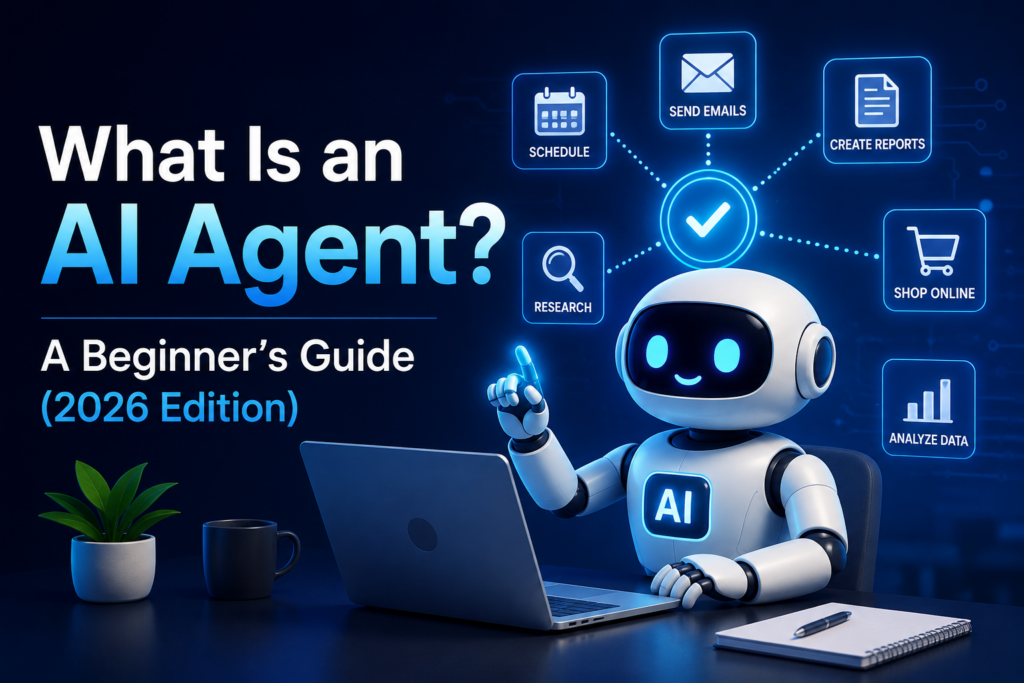
An AI agent can perform actions in addition to answering questions.
Examples include:
- Scheduling meetings
- Managing calendars
- Booking travel
- Ordering supplies
- Monitoring data
- Sending emails automatically
- Completing repetitive business tasks
In simple terms:
A chatbot talks.
An AI agent acts.
Real-World Examples of AI Agents
AI agents are already being used in many industries.
Some examples include:
Personal Assistants
Helping manage calendars, reminders, and daily schedules.
Customer Support
Automatically solving customer problems before a human representative becomes involved.
Business Operations
Handling repetitive office tasks like processing invoices or updating databases.
Software Development
Writing code, testing applications, and fixing programming errors.
Research
Gathering information from multiple sources and organizing it into reports.
Benefits of AI Agents
AI agents offer several important advantages.
Save Time
They automate repetitive work that would otherwise require manual effort.
Increase Productivity
People can focus on more important tasks while AI handles routine work.
Work Around the Clock
Unlike humans, AI agents can operate 24 hours a day.
Reduce Human Error
Automated processes often reduce mistakes caused by repetitive tasks.
Handle Multiple Tasks
Some AI agents can manage several projects or workflows at the same time.
Limitations of AI Agents
Despite their capabilities, AI agents still have limitations.
They may:
- Misunderstand complex instructions
- Make incorrect decisions
- Depend on outdated information
- Require human approval for important actions
- Raise privacy and security concerns when connected to personal accounts
For these reasons, human oversight remains essential.
Are AI Agents Replacing Jobs?
Not entirely.
Many businesses use AI agents to automate repetitive tasks, allowing employees to spend more time on creative thinking, problem-solving, and customer relationships.
While some job responsibilities may change, AI agents are generally viewed as tools that assist people rather than replace them completely.
Learning how to work alongside AI may become an increasingly valuable skill.
Why Are AI Agents So Important?
Many technology experts believe AI agents represent the next evolution of artificial intelligence.
Instead of simply answering questions, AI systems are becoming capable of completing real work.
As AI continues to improve, agents may help individuals and businesses save time, increase productivity, and automate everyday tasks more efficiently than ever before.
Frequently Asked Questions
Is ChatGPT an AI agent?
ChatGPT is primarily a conversational AI assistant. However, when connected to tools or automation features, it can perform some agent-like tasks.
Can AI agents make decisions?
Yes. AI agents can make decisions based on the information available to them and the goals they are given.
Do AI agents learn over time?
Some AI agents can improve their performance through feedback or additional training, depending on how they are designed.
Are AI agents free?
Some AI agents are available for free, while more advanced business-focused agents often require paid subscriptions.
Will everyone use AI agents in the future?
Many experts believe AI agents will become increasingly common as businesses and consumers look for ways to automate everyday tasks.
Final Thoughts
AI agents represent an exciting step forward in artificial intelligence. Instead of simply providing answers, they can plan, make decisions, and carry out tasks to help users achieve their goals.
As AI technology continues to advance, AI agents are expected to become more capable, more reliable, and more common in both personal and professional life. Understanding what AI agents are today will help you better understand the future of artificial intelligence.