
Today, it’s easy to ask ChatGPT almost anything.
Need help writing an email?
Ask ChatGPT.
Need a recipe?
Ask ChatGPT.
Need help understanding homework?
Ask ChatGPT.
Need vacation ideas, business advice, coding help, or a workout plan?
ChatGPT has become the first place millions of people turn when they need information.
But it wasn’t always that way.
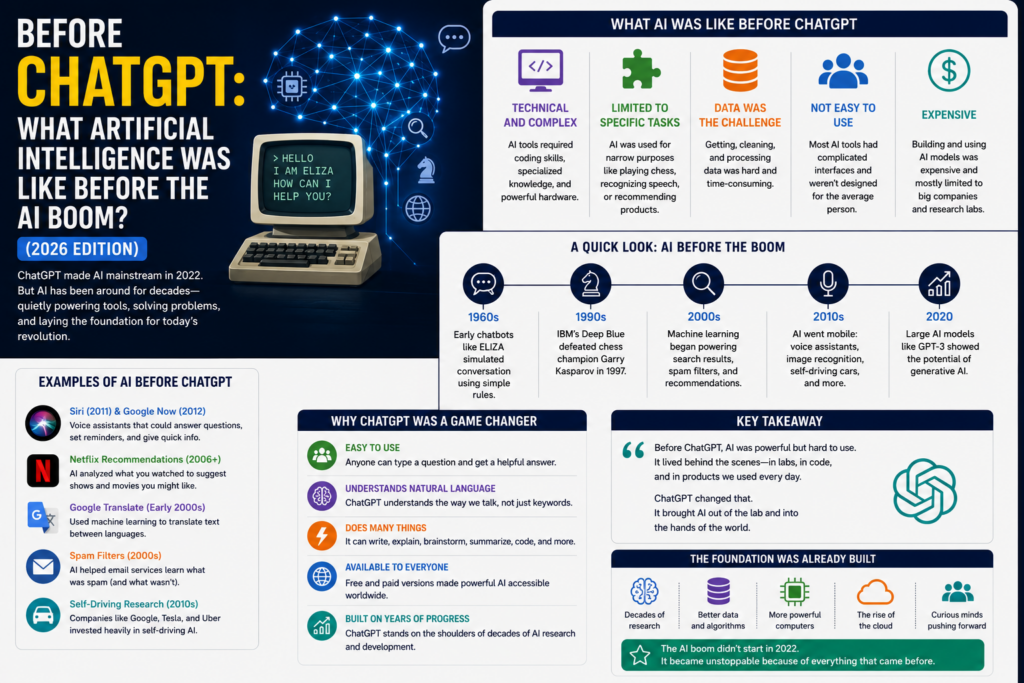
In fact, before ChatGPT launched in late 2022, using artificial intelligence looked very different.
Although AI had existed for decades, it wasn’t something most people interacted with directly. Instead, it quietly worked behind the scenes in apps, websites, and devices we used every day.
So what was life like before ChatGPT?
Let’s take a trip back through the history of AI.
Before AI Was Mainstream
Long before conversational AI became popular, computers were already helping people solve problems.
However, they weren’t intelligent in the way modern AI feels today.
Most software followed fixed rules.
If you wanted information, you usually had to search for it yourself.
People relied on:
- Google Search
- Wikipedia
- Online forums
- YouTube tutorials
- Stack Overflow
- Quora
- Blogs
- Instruction manuals
Instead of asking one intelligent assistant a question, you often searched through multiple websites looking for an answer.
ELIZA: The First Chatbot (1966)
One of the earliest chatbots was ELIZA, created by computer scientist Joseph Weizenbaum at MIT.
ELIZA simulated a conversation by acting like a psychotherapist.
For example:
You: “I’m feeling stressed.”
ELIZA: “Why do you think you’re feeling stressed?”
It didn’t actually understand emotions or language.
Instead, it recognized keywords and responded using simple patterns.
Despite its simplicity, many people were amazed by how natural the conversations felt.
ELIZA proved that even simple computer programs could make people feel like they were talking to another person.
A.L.I.C.E. (1995)
Nearly thirty years later, another chatbot became popular online.
It was called A.L.I.C.E. (Artificial Linguistic Internet Computer Entity).
Unlike ChatGPT, A.L.I.C.E. wasn’t learning from massive amounts of data.
It relied on thousands of hand-written rules created by developers.
People enjoyed chatting with it, but conversations often became repetitive because it couldn’t truly understand context.
Still, A.L.I.C.E. showed that interest in conversational AI was growing.
SmarterChild (2001)
If you used AOL Instant Messenger (AIM) or MSN Messenger, you may remember SmarterChild.
For many people, this was their first real chatbot.
SmarterChild could answer questions about:
- Weather
- Sports scores
- Movie times
- Definitions
- Basic facts
- Jokes
While limited by today’s standards, it felt incredibly futuristic at the time.
Instead of visiting multiple websites, people could simply send a message and receive an answer.
IBM Watson Changes the Conversation (2011)
Artificial intelligence received worldwide attention when IBM Watson competed on the television quiz show Jeopardy!
Watson defeated two of the greatest Jeopardy! champions in history.
The victory shocked many people.
It demonstrated that AI could understand complex questions, search enormous amounts of information, and respond remarkably quickly.
Although Watson wasn’t a chatbot like ChatGPT, it proved AI was becoming much more capable.
The Rise of Voice Assistants
The next major step came through smartphones and smart speakers.
Siri (2011)
Apple introduced Siri, allowing people to speak naturally to their phones.
Users could ask questions like:
- “What’s the weather?”
- “Set an alarm.”
- “Call Mom.”
For millions of people, Siri became their first experience talking to AI.
Google Now (2012)
Google introduced Google Now, which later evolved into Google Assistant.
It focused on providing helpful information before users even asked for it.
Amazon Alexa (2014)
Smart speakers entered millions of homes.
People began asking Alexa to:
- Play music
- Tell jokes
- Set timers
- Read the news
- Control smart home devices
Voice assistants made AI more accessible than ever before.
Microsoft Cortana (2014)
Microsoft joined the race with Cortana.
Integrated into Windows, Cortana helped users search files, manage calendars, and perform voice commands.
Although it never reached the popularity of Siri or Alexa, it demonstrated how quickly AI assistants were becoming part of everyday technology.
AI Was Everywhere—But Few People Realized It
Even before ChatGPT, AI was already working quietly behind the scenes.
It powered:
- Netflix recommendations
- Amazon product suggestions
- Google Maps navigation
- Gmail spam filtering
- Facebook and Instagram feeds
- Online shopping recommendations
- Fraud detection by banks
- Photo organization on smartphones
Most people used AI every single day.
They just didn’t think of it as “using AI.”
GPT-2 and GPT-3: The Technology Was Improving
Before ChatGPT, OpenAI released increasingly powerful language models.
GPT-2 (2019)
GPT-2 amazed researchers because it could generate surprisingly realistic text.
However, it wasn’t designed for everyday users.
Most people never interacted with it directly.
GPT-3 (2020)
GPT-3 represented another enormous leap forward.
Developers began building applications using its technology.
But for the average person, AI still wasn’t something you simply opened and started chatting with.
It remained mostly behind the scenes.
Then Everything Changed
On November 30, 2022, OpenAI released ChatGPT.
Suddenly, AI became incredibly easy to use.
There was no complicated software.
No programming experience.
No technical knowledge.
People simply opened a webpage, typed a question, and received an intelligent response within seconds.
For millions of people, this was the first time AI felt genuinely useful.
Within months, students, teachers, businesses, writers, programmers, artists, and entrepreneurs were using ChatGPT every day.
Artificial intelligence had officially entered the mainstream.
Life Before ChatGPT
Looking back, life before ChatGPT wasn’t necessarily harder—but it often took longer to accomplish everyday tasks.
Imagine wanting to write a professional email.
Before ChatGPT, you might search Google for examples, read several articles, and piece together your own draft.
Need help with Excel?
You’d probably watch a 20-minute YouTube tutorial.
Want to learn a new topic?
You might browse Wikipedia, read blog posts, search Reddit, and compare multiple websites before finding the answer you needed.
ChatGPT didn’t replace the internet.
Instead, it changed how many people interact with it.
Rather than searching through dozens of pages, people could begin with a conversation.
Why ChatGPT Felt Different
Many earlier AI systems could answer questions.
What made ChatGPT different was its ability to carry on natural conversations.
It could remember context within a conversation, explain ideas in different ways, revise its own responses, and adapt to a user’s requests.
Instead of feeling like a search engine, it felt more like talking to a knowledgeable assistant.
That simple change transformed public expectations of what AI could do.
Frequently Asked Questions
Was there AI before ChatGPT?
Yes.
Artificial intelligence has existed for decades and was already being used in search engines, recommendation systems, voice assistants, navigation apps, and many other technologies long before ChatGPT was released.
Was ChatGPT the first chatbot?
No.
Earlier chatbots such as ELIZA, A.L.I.C.E., and SmarterChild introduced conversational computing years before ChatGPT.
However, ChatGPT made conversational AI far more capable and accessible.
Why did ChatGPT become so popular?
Unlike earlier chatbots, ChatGPT could generate detailed, natural-sounding responses across an enormous range of topics.
It was also simple enough that almost anyone could begin using it immediately.
Did ChatGPT replace Google?
Not entirely.
Many people now use ChatGPT for brainstorming, explanations, and writing assistance, while still relying on search engines for current news, shopping, maps, and navigating the web.
The two often complement each other rather than compete directly.
Final Thoughts
The story of ChatGPT didn’t begin in 2022.
It began decades earlier with researchers who believed computers could one day communicate more naturally with people.
From ELIZA’s simple conversations in the 1960s to SmarterChild on instant messaging, from Siri and Alexa to GPT-2 and GPT-3, each generation of AI brought us one step closer to today’s intelligent assistants.
Then, in late 2022, ChatGPT connected all of those decades of progress into one experience that anyone could use.
For millions of people, it was their first real conversation with artificial intelligence.
And once they experienced it, expectations for technology changed forever.
Looking back at life before ChatGPT reminds us of something important:
Artificial intelligence didn’t appear overnight.
It evolved through decades of research, experimentation, setbacks, and breakthroughs—all leading to the moment when AI became a tool that everyday people could use to learn, create, and solve problems.
That journey is still unfolding, and we’re only beginning to see what the next chapter will bring.