
Today, artificial intelligence seems impossible to ignore.
New AI tools appear almost every week.
Businesses are investing billions of dollars.
Students use AI to study.
Companies use it to improve productivity.
Researchers are using AI to help solve scientific problems.
Looking at today’s rapid progress, it’s easy to assume artificial intelligence has always been on this path.
It hasn’t.
In fact, there were times when many experts believed AI had failed.
Funding disappeared.
Research slowed dramatically.
Public excitement faded.
Some people even thought artificial intelligence might never become useful.
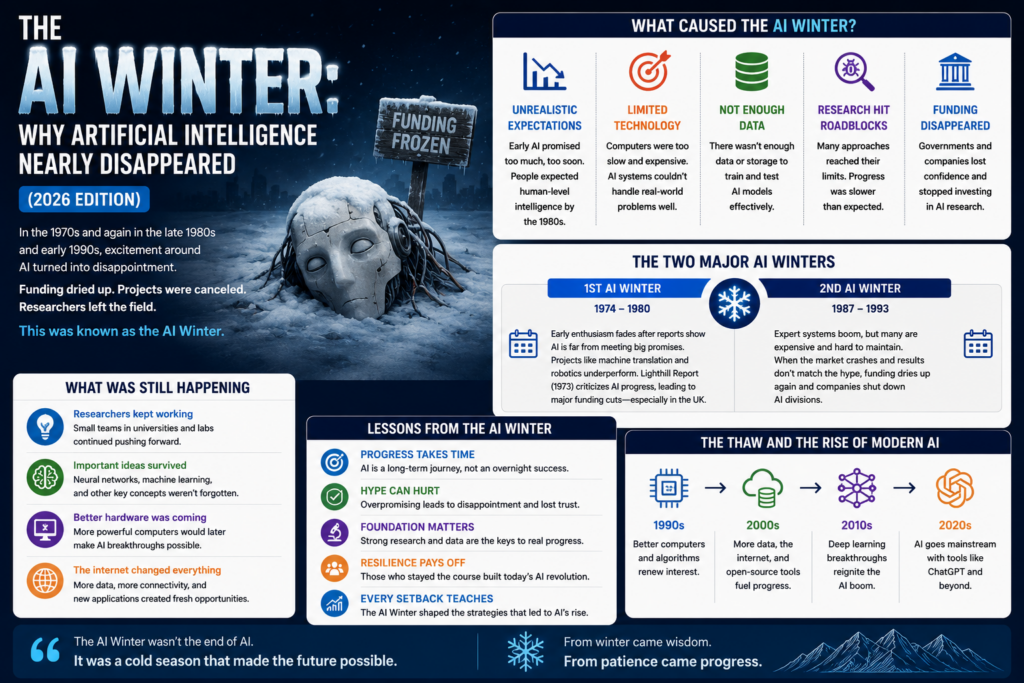
These difficult periods became known as AI Winters.
Understanding them helps explain why today’s AI revolution is so extraordinary.
What Is an AI Winter?
An AI Winter is a period when interest, funding, and research in artificial intelligence decline significantly.
Instead of rapid progress and excitement, AI enters a period of disappointment.
This usually happens because expectations become much higher than what the available technology can actually deliver.
When people lose confidence, investment slows and research becomes much more difficult.
Think of an AI Winter like a harsh winter season.
Growth slows.
Progress becomes difficult.
Many projects simply don’t survive.
Why Did AI Winters Happen?
Artificial intelligence has always inspired big dreams.
Researchers imagined machines that could:
- Understand language
- Solve complex problems
- Learn like humans
- Make intelligent decisions
The problem wasn’t the vision.
The problem was timing.
During the 1950s, 1960s, and 1970s, computers simply weren’t powerful enough to accomplish many of these ambitious goals.
Researchers made exciting predictions, but the technology couldn’t keep up.
As expectations grew faster than actual progress, disappointment followed.
The First AI Winter (1970s)
The first major AI Winter arrived during the 1970s.
Early AI systems showed promise in laboratories, but they struggled outside carefully controlled environments.
Computers had serious limitations.
They lacked:
- Processing power
- Memory
- Large datasets
- Advanced algorithms
Tasks that seemed simple for humans—such as understanding everyday language or recognizing objects—proved incredibly difficult for machines.
Governments and funding organizations began questioning whether AI research was worth the investment.
Many research projects lost financial support.
Some laboratories closed entirely.
The Second AI Winter (Late 1980s–1990s)
Artificial intelligence experienced renewed excitement during the 1980s with the rise of Expert Systems.
These programs were designed to imitate the decision-making abilities of specialists in fields such as medicine, engineering, and finance.
At first, businesses were enthusiastic.
But Expert Systems had major drawbacks.
They were:
- Expensive to build
- Difficult to maintain
- Limited to narrow tasks
- Hard to update as knowledge changed
Companies that expected AI to revolutionize their industries became disappointed.
Investment declined once again.
This period became known as the Second AI Winter.
Did AI Research Stop?
No.
This is one of the biggest misconceptions about AI Winters.
Research never completely stopped.
Instead, it continued quietly in universities, research laboratories, and technology companies.
Scientists kept improving:
- Machine Learning
- Neural Networks
- Computer Vision
- Robotics
- Speech Recognition
The progress was slower and received far less public attention, but important breakthroughs continued behind the scenes.
Many of today’s AI technologies were built upon research that survived these difficult years.
What Ended the AI Winter?
Several major developments helped AI recover.
Computers became dramatically faster.
The internet produced enormous amounts of digital data.
Cloud computing made powerful hardware more accessible.
Researchers developed better Machine Learning techniques.
Eventually, Deep Learning transformed what AI systems could accomplish.
Together, these advances created the conditions AI had needed all along.
The ideas were often decades old.
The technology had finally caught up.
The Rise of Modern AI
During the 2010s, AI began achieving results that once seemed impossible.
Artificial intelligence became much better at:
- Recognizing images
- Understanding speech
- Translating languages
- Playing complex games
- Recommending content
- Understanding written language
Public confidence returned.
Businesses invested billions.
Governments expanded AI research.
Universities created new AI programs.
Artificial intelligence was no longer viewed as a failed experiment.
It had become one of the world’s fastest-growing technologies.
Lessons From the AI Winters
The AI Winters teach several important lessons.
Technology Needs Time
Groundbreaking ideas often require decades before technology catches up.
Many concepts discussed during the 1950s became practical only after enormous improvements in computing power.
Expectations Matter
When excitement grows faster than real progress, disappointment often follows.
Responsible expectations help create steady, sustainable innovation.
Scientific Progress Isn’t Always Fast
History often remembers breakthroughs.
It sometimes forgets the years of slow research, failed experiments, and patient persistence that made those breakthroughs possible.
Persistence Pays Off
If researchers had abandoned AI during the Winters, today’s remarkable AI systems might never have existed.
Their willingness to continue despite setbacks changed history.
Why AI Winters Still Matter Today
Some experts occasionally ask whether another AI Winter could happen.
It’s impossible to know.
Today’s AI industry is much larger, better funded, and supported by dramatically more powerful technology than during previous decades.
However, history reminds us to balance excitement with realistic expectations.
Artificial intelligence is advancing rapidly, but it still has important limitations.
Understanding those limitations helps create healthier conversations about AI’s future.
Frequently Asked Questions
What is an AI Winter?
An AI Winter is a period when funding, public interest, and research in artificial intelligence decline because progress fails to meet expectations.
How many AI Winters have there been?
Most historians recognize two major AI Winters:
- The first during the 1970s
- The second during the late 1980s and early 1990s
Why did AI nearly disappear?
It didn’t disappear completely.
Funding decreased because early computers lacked the power needed to achieve many ambitious AI goals.
Research continued, but at a much slower pace.
Could another AI Winter happen?
Some experts believe it’s possible if expectations significantly exceed what AI can realistically deliver.
Others believe today’s technology and investment make another major AI Winter less likely.
No one knows for certain.
Final Thoughts
The history of artificial intelligence isn’t just a story of success.
It’s also a story of setbacks, disappointment, and perseverance.
Twice, the world believed AI had promised more than it could deliver.
Twice, funding declined and public enthusiasm faded.
Yet researchers continued asking difficult questions, improving algorithms, and patiently building the foundation for the future.
Today, we benefit from that persistence every time we use an AI assistant, receive personalized recommendations, generate images, or interact with intelligent software.
The AI revolution didn’t happen overnight.
It survived two long winters before reaching today’s remarkable spring.
Understanding that journey reminds us that progress isn’t always a straight line.
Sometimes the most important breakthroughs happen quietly—long before the rest of the world notices.
And perhaps that’s the greatest lesson of the AI Winters:
Great ideas don’t disappear simply because they’re ahead of their time.