
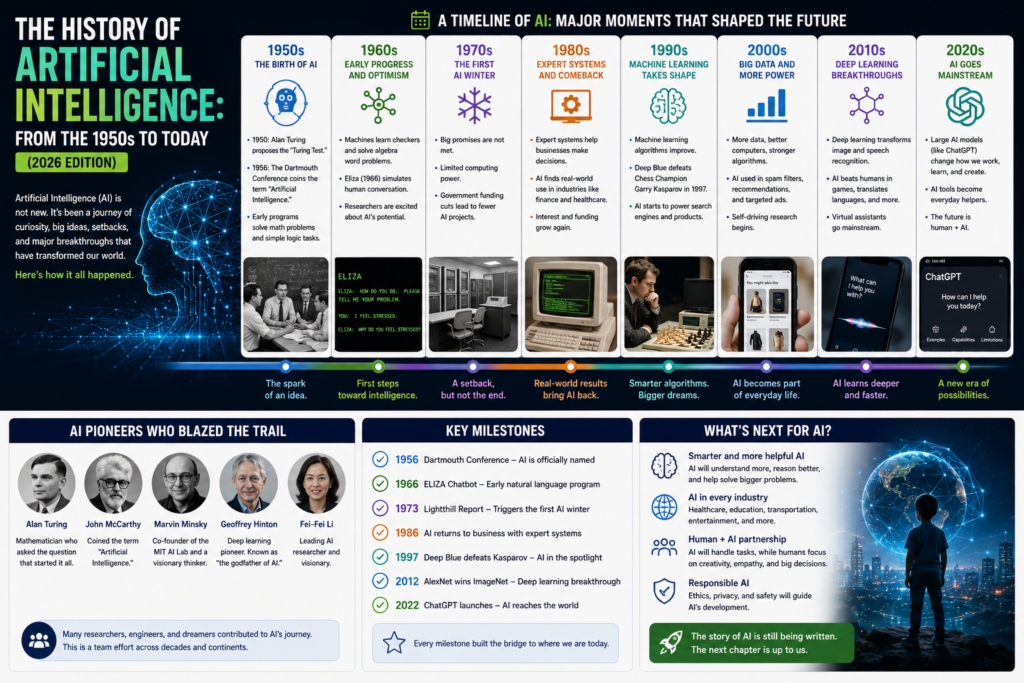
Artificial intelligence might seem like a brand-new technology.
After all, tools like ChatGPT, AI image generators, and virtual assistants have only become household names in recent years.
But the truth is, AI has been evolving for more than 70 years.
Its journey has included incredible breakthroughs, long periods of disappointment, world-changing discoveries, and technological leaps that once seemed impossible.
Understanding where AI came from helps us better understand where it’s going.
Let’s take a journey through the fascinating history of artificial intelligence.
Before Artificial Intelligence Had a Name
Long before the phrase “Artificial Intelligence” existed, scientists and mathematicians were already asking an ambitious question:
Could machines ever think?
One of the earliest people to seriously explore this idea was Alan Turing, a brilliant British mathematician.
In 1936, Turing introduced the concept of the Turing Machine, demonstrating how a machine could solve problems by following logical instructions.
Years later, in 1950, he proposed what became known as the Turing Test, a way to evaluate whether a machine could imitate human conversation convincingly enough to appear intelligent.
Although computers were still in their infancy, Turing’s ideas would become the foundation of modern computer science and artificial intelligence.
The Birth of Artificial Intelligence (1956)
The year 1956 is widely considered the official birth of Artificial Intelligence as a scientific field.
That summer, a group of researchers gathered at Dartmouth College in New Hampshire for what became known as the Dartmouth Summer Research Project on Artificial Intelligence.
During this conference, computer scientist John McCarthy introduced the term:
“Artificial Intelligence.”
The researchers believed computers might eventually:
- Solve problems
- Learn from experience
- Understand language
- Play games
- Mimic aspects of human intelligence
Their optimism was enormous.
Many believed machines with human-level intelligence might be developed within a few decades.
They underestimated just how difficult that challenge would be.
The Early Years (1950s–1960s)
The first AI programs were surprisingly impressive for their time.
Researchers developed systems capable of:
- Solving mathematical problems
- Playing simple games
- Proving logical theorems
- Following basic instructions
Although these programs were limited, they demonstrated that computers could perform tasks once thought to require human intelligence.
Governments and universities began investing heavily in AI research.
Many believed a technological revolution was just around the corner.
The First AI Winter (1970s)
Unfortunately, progress slowed dramatically.
Researchers had made ambitious promises, but computers simply weren’t powerful enough to achieve them.
AI systems struggled with:
- Understanding language
- Recognizing objects
- Learning efficiently
- Solving real-world problems
As excitement faded, funding for AI research declined sharply.
This period became known as the AI Winter.
Projects were canceled.
Research slowed.
Many people believed AI had failed.
A Second Wave of Optimism (1980s)
During the 1980s, AI experienced a revival.
One major breakthrough came through Expert Systems.
Instead of trying to make computers think like humans, researchers built systems designed to solve very specific problems.
Expert Systems became useful in areas such as:
- Medicine
- Manufacturing
- Engineering
- Financial analysis
Businesses began investing in AI once again.
For a time, optimism returned.
Another AI Winter (Late 1980s–1990s)
Unfortunately, history repeated itself.
Expert Systems proved expensive to build and maintain.
Many companies became disappointed when AI failed to meet unrealistic expectations.
Investment declined again.
This second slowdown became known as the Second AI Winter.
Although AI research continued quietly, it received much less public attention.
Machine Learning Changes Everything (1990s–2000s)
Instead of programming every rule manually, researchers began teaching computers to learn from data.
This approach became known as Machine Learning.
Rather than telling computers exactly what to do, developers provided large amounts of information and allowed algorithms to discover patterns on their own.
This marked a major shift in AI development.
As computers became faster and more data became available, Machine Learning steadily improved.
Deep Learning Sparks a Revolution (2010s)
The next major breakthrough came through Deep Learning.
Powered by artificial neural networks and vastly improved computer hardware, Deep Learning allowed AI to achieve remarkable results.
AI systems became dramatically better at:
- Image recognition
- Speech recognition
- Language translation
- Recommendation systems
- Medical diagnosis
- Autonomous driving research
Many of today’s AI technologies trace their success back to advances made during this decade.
AI Becomes Part of Everyday Life
By the late 2010s, millions of people were already using AI without realizing it.
Artificial intelligence quietly powered:
- Netflix recommendations
- Google Search
- Spam filters
- Smartphone cameras
- Navigation apps
- Voice assistants
- Online shopping recommendations
- Social media feeds
AI was no longer a laboratory experiment.
It had become part of everyday life.
The Rise of Generative AI (2020s)
The 2020s introduced one of the biggest transformations in AI history.
Instead of simply analyzing information, AI began creating it.
This new generation of Generative AI could produce:
- Articles
- Images
- Music
- Videos
- Computer code
- Business plans
- Marketing content
Millions of people suddenly had access to powerful AI assistants capable of helping with work, education, creativity, and everyday life.
Artificial intelligence moved from research labs into homes, classrooms, and businesses around the world.
Where AI Is Today
Today, artificial intelligence is being used across nearly every industry.
Examples include:
- Healthcare
- Education
- Finance
- Manufacturing
- Agriculture
- Entertainment
- Transportation
- Scientific research
- Customer service
- Small businesses
AI continues improving at an extraordinary pace, with new tools and capabilities appearing almost every month.
What Does the Future Hold?
No one knows exactly what artificial intelligence will look like in the next 10 or 20 years.
Researchers continue exploring areas such as:
- More capable AI assistants
- Robotics
- Scientific discovery
- Personalized education
- Medical research
- Autonomous transportation
- Artificial General Intelligence (AGI)
While predictions vary, one thing is certain:
AI will continue shaping how we work, learn, communicate, and solve problems.
Frequently Asked Questions
When was Artificial Intelligence invented?
Artificial Intelligence became an official field of study in 1956 during the Dartmouth Conference, where the term “Artificial Intelligence” was first introduced.
Who invented AI?
No single person invented AI.
However, pioneers such as Alan Turing, John McCarthy, Marvin Minsky, Allen Newell, and Herbert A. Simon played major roles in its early development.
Why did AI experience “AI Winters”?
AI Winters occurred because early expectations greatly exceeded what the available technology could actually accomplish.
Funding decreased when researchers failed to deliver the breakthroughs many people expected.
Why has AI advanced so quickly recently?
Several factors came together:
- Faster computers
- Larger datasets
- Better algorithms
- Deep Learning
- Cloud computing
- Massive investments in AI research
Together, these advances accelerated AI development dramatically.
Final Thoughts
The story of artificial intelligence isn’t one of constant success.
It’s a story of bold ideas, unexpected setbacks, remarkable perseverance, and extraordinary innovation.
Over the past seven decades, AI has evolved from a small academic research project into one of the most influential technologies in human history.
Along the way, brilliant researchers imagined possibilities that seemed impossible at the time. Some ideas failed. Others took decades to mature. Many required technology that simply didn’t exist yet.
Today, we’re living through one of the most exciting chapters in that story.
Artificial intelligence continues to evolve at an incredible pace, transforming industries, creating new opportunities, and changing the way people work, learn, and create.
Understanding AI’s history helps us appreciate an important truth:
The tools we use today didn’t appear overnight.
They are the result of generations of curiosity, experimentation, and determination by researchers who believed machines could one day accomplish extraordinary things.
And if history has taught us anything, it’s that the story of artificial intelligence is far from over.