
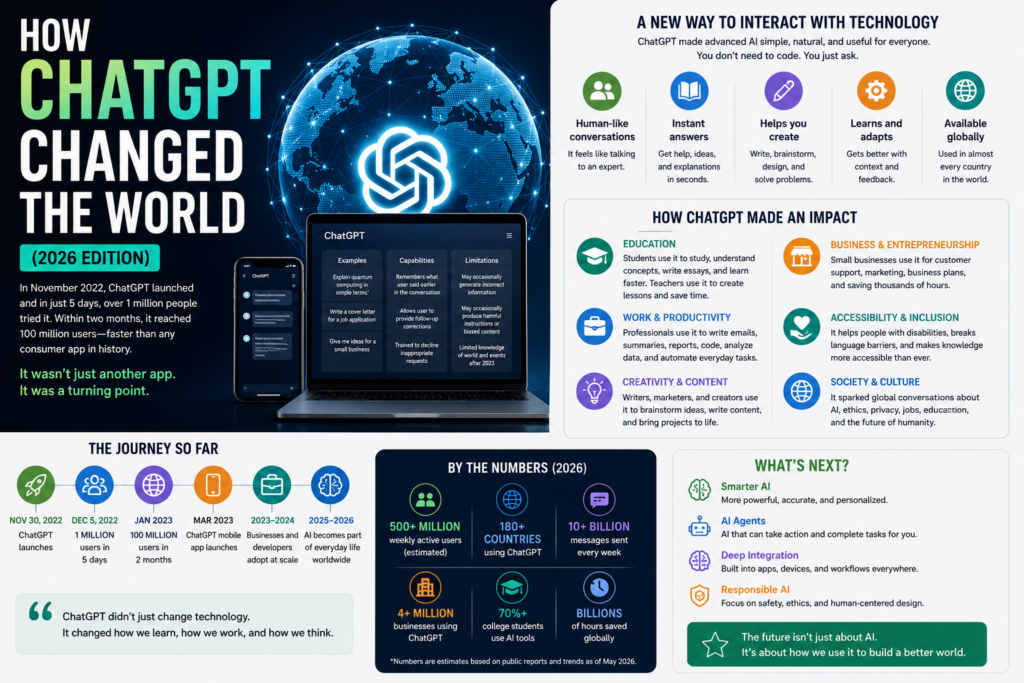
On November 30, 2022, a new artificial intelligence tool became available to the public.
Its name was ChatGPT.
At first, many people assumed it was simply another chatbot.
Within weeks, it became clear that it was something much bigger.
Students were using it to study.
Teachers were redesigning assignments.
Businesses were writing marketing content.
Programmers were generating code.
Writers were brainstorming ideas.
Millions of people who had never thought about artificial intelligence were suddenly using it every day.
Although AI had existed for decades, ChatGPT introduced it to the general public in a way that no previous technology had.
Many historians may eventually view its release as one of the most important moments in the history of computing.
Before ChatGPT
Artificial intelligence didn’t begin with ChatGPT.
Long before its release, AI was already working quietly behind the scenes.
It powered:
- Search engines
- Email spam filters
- Voice assistants
- Navigation apps
- Online shopping recommendations
- Translation services
- Social media feeds
Most people used AI every day without realizing it.
The difference was simple:
People experienced AI…
They didn’t interact with it.
ChatGPT changed that.
What Made ChatGPT Different?
Previous chatbots often felt limited.
They could answer simple questions, but conversations quickly became frustrating.
ChatGPT felt different.
Instead of relying on scripted responses, it could:
- Hold natural conversations
- Explain complicated topics
- Write essays
- Summarize books
- Generate computer code
- Brainstorm business ideas
- Create lesson plans
- Draft emails
- Translate languages
For many users, it was the first time a computer felt genuinely conversational.
That experience surprised millions of people.
AI Became Personal
Perhaps ChatGPT’s greatest achievement wasn’t technical.
It was psychological.
Instead of watching AI from a distance, people began working with it directly.
Someone could ask:
“Help me write my resume.”
Or:
“Explain black holes like I’m ten years old.”
Or:
“Plan a week’s worth of healthy meals.”
The AI responded instantly.
For the first time, everyday people could experience advanced AI without needing technical knowledge.
That changed public perception almost overnight.
Education Changed
Schools and universities immediately began discussing ChatGPT.
Some educators worried students would use it to complete assignments.
Others recognized its potential as a learning tool.
Students began using ChatGPT to:
- Explain difficult concepts
- Create study guides
- Practice quizzes
- Improve writing
- Organize research
- Learn new skills
Rather than replacing education, ChatGPT sparked new conversations about how education should evolve alongside AI.
The Workplace Changed
Businesses quickly realized AI could improve productivity.
Professionals began using ChatGPT to:
- Draft emails
- Write reports
- Summarize meetings
- Brainstorm ideas
- Create presentations
- Organize projects
- Research unfamiliar topics
Instead of replacing workers, many organizations discovered that AI could handle repetitive tasks, allowing employees to focus on more creative and strategic work.
Content Creation Changed
Content creators embraced AI almost immediately.
Writers, YouTubers, marketers, musicians, designers, and entrepreneurs found new ways to speed up their creative process.
ChatGPT became a powerful brainstorming partner.
It helped creators:
- Generate ideas
- Write scripts
- Build outlines
- Improve articles
- Create marketing copy
- Organize production schedules
The most successful creators didn’t stop creating.
They simply had a new tool that helped them create more efficiently.
Businesses Raced to Catch Up
The success of ChatGPT changed the technology industry almost overnight.
Companies around the world accelerated their AI efforts.
Major technology companies introduced new AI products, expanded existing research, and invested billions of dollars into artificial intelligence.
Suddenly, AI wasn’t a future project.
It became a present-day priority.
Everyday Life Changed
Today, millions of people use conversational AI for everyday tasks.
Some ask for cooking recipes.
Others plan vacations.
Many use AI to improve resumes, solve math problems, organize schedules, or brainstorm business ideas.
Artificial intelligence became something people use—not just something they read about.
That shift may be ChatGPT’s greatest legacy.
Challenges Along the Way
Despite its success, ChatGPT also introduced important challenges.
People quickly discovered that AI could:
- Generate incorrect information
- Produce convincing mistakes
- Reflect biases found in training data
- Raise privacy concerns
- Change how schools and workplaces operate
These challenges continue to shape discussions about responsible AI development.
The rapid adoption of AI has created new opportunities—but also new responsibilities.
A New Era of AI
The release of ChatGPT marked the beginning of a new chapter in technology.
Since then, artificial intelligence has expanded rapidly into areas including:
- Image generation
- Music creation
- Video production
- Scientific research
- Healthcare
- Software development
- Customer service
- Business automation
What once seemed like science fiction has quickly become part of everyday life.
Frequently Asked Questions
When was ChatGPT released?
ChatGPT became publicly available on November 30, 2022.
Why did ChatGPT become so popular?
Its ability to hold natural conversations and assist with a wide variety of tasks made advanced AI accessible to millions of people for the first time.
Did ChatGPT invent Artificial Intelligence?
No.
Artificial intelligence has existed for decades.
ChatGPT built upon years of research in machine learning, deep learning, and large language models.
Why is ChatGPT considered historically important?
Because it introduced conversational AI to the general public on an unprecedented scale, dramatically increasing awareness and adoption of artificial intelligence around the world.
Final Thoughts
Throughout history, certain technologies have changed the way people live.
The printing press made knowledge more accessible.
The telephone transformed communication.
The internet connected the world.
Smartphones put powerful computers into our pockets.
ChatGPT represents another important milestone in that ongoing story.
It didn’t invent artificial intelligence, but it introduced AI to millions of people in a way that felt practical, useful, and surprisingly human.
Almost overnight, artificial intelligence shifted from being something many people had heard about to something they could use every day.
Its influence extends far beyond writing essays or answering questions.
It has changed education, business, creativity, software development, and countless everyday tasks—while also sparking important conversations about ethics, privacy, and the future of work.
Whether future AI systems become even more capable or evolve in entirely new directions, one thing is clear:
The release of ChatGPT marked the beginning of a new era in human-computer interaction.
Years from now, people may look back on November 30, 2022, as the day artificial intelligence truly entered everyday life.
And for millions of people around the world, that journey began with a simple prompt and a blinking cursor.