
When people talk about artificial intelligence, names like ChatGPT, Google Gemini, and OpenAI often dominate the conversation.
But decades before any of these technologies existed, one man imagined a future where machines could solve problems, process information, and perhaps even think in ways that resembled human intelligence.
His name was Alan Turing.
Although he never lived to see modern computers or artificial intelligence become reality, many of the ideas that power today’s technology can be traced back to his groundbreaking work.
For that reason, Alan Turing is widely regarded as one of the most influential mathematicians and computer scientists in history—and is often called the Father of Modern Computing.
Early Life
Alan Mathison Turing was born on June 23, 1912, in London, England.
From a young age, he showed an extraordinary talent for mathematics and solving difficult problems.
Unlike many children his age, Turing loved exploring how things worked. He was fascinated by numbers, patterns, logic, and science.
His curiosity eventually led him to study mathematics at the prestigious University of Cambridge, where his remarkable abilities quickly became apparent.
It was there that he began developing ideas that would eventually change the world.
The Idea That Changed Computing
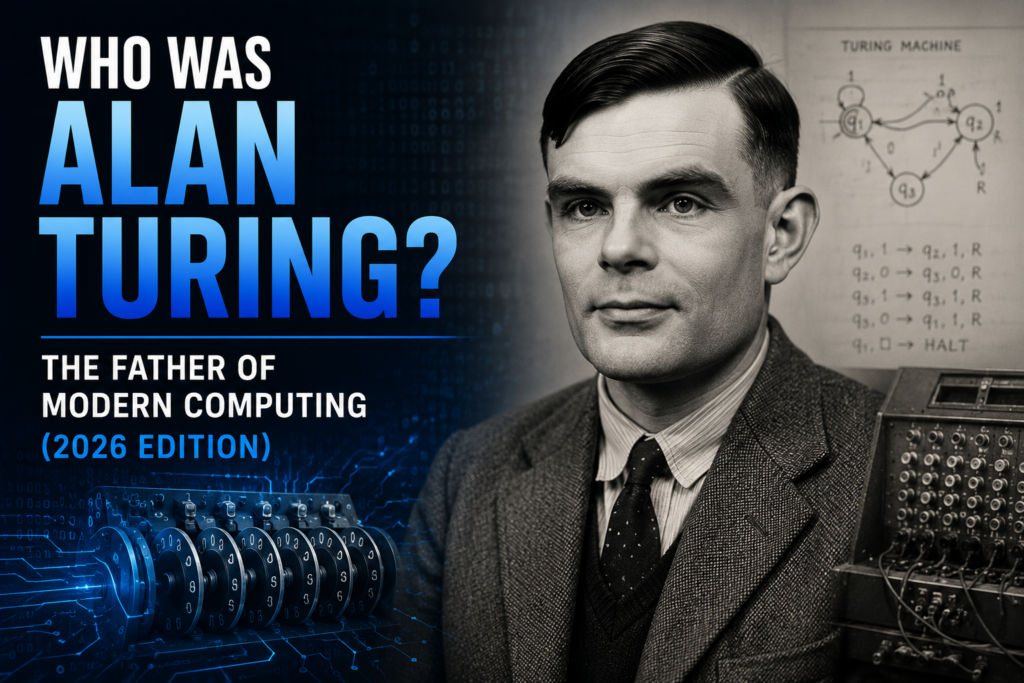
In 1936, long before modern computers existed, Turing published a research paper that introduced an imaginary machine now known as the Turing Machine.
The Turing Machine wasn’t a physical computer.
It was a thought experiment designed to answer a simple but powerful question:
“What problems can a machine solve if it follows instructions?”
Although simple in concept, this idea became one of the foundations of computer science.
The Turing Machine demonstrated that a machine could process information by following a sequence of logical instructions—an idea that still forms the basis of modern computing.
Every laptop, smartphone, tablet, and server in existence today follows the same basic principle.
Breaking the Enigma Code
Alan Turing’s greatest contribution during his lifetime came during World War II.
At the time, Germany used an encryption device called the Enigma machine to send secret military messages.
The code produced by Enigma changed constantly and was considered nearly impossible to break.
If the Allies couldn’t read those messages, they would struggle to predict German military movements.
Turing joined a secret team of mathematicians and engineers at Bletchley Park, Britain’s codebreaking headquarters.
There, he helped design an electromechanical machine known as the Bombe, which dramatically sped up the process of deciphering Enigma-encrypted messages.
This breakthrough allowed Allied forces to gather critical intelligence throughout the war.
Many historians believe Turing’s work helped shorten World War II by several years and saved millions of lives.
Although his contributions remained classified for decades, they are now recognized as one of the greatest achievements in military intelligence history.
Could Machines Think?
After the war, Turing turned his attention back to computing.
As computers became more advanced, he began asking a question that seemed almost impossible at the time:
“Can machines think?”
This question would eventually become one of the foundations of artificial intelligence.
In 1950, Turing published a landmark paper titled “Computing Machinery and Intelligence.”
Instead of trying to define intelligence directly, he proposed a different way of thinking about the problem.
If a machine could hold a conversation so convincingly that a person couldn’t reliably tell whether they were speaking to another human or a computer, could that machine be considered intelligent?
This idea became known as the Turing Test.
What Is the Turing Test?
The Turing Test remains one of the most famous concepts in AI history.
Here’s a simplified explanation.
Imagine you’re communicating through a computer with two hidden participants:
- One is another person.
- The other is a computer.
If you can’t reliably determine which one is the computer after asking questions, the machine has successfully passed the test.
The Turing Test doesn’t prove that a machine truly “thinks.”
Instead, it measures whether its responses are convincing enough to appear human.
Even today, the Turing Test continues to influence discussions about artificial intelligence, even though many researchers now use additional ways to evaluate AI systems.
Why Alan Turing Matters Today
Turing never saw smartphones.
He never used the internet.
He never experienced modern AI.
Yet many of the technologies we use every day exist because of the ideas he introduced nearly a century ago.
His work laid the foundation for:
- Modern computers
- Computer programming
- Artificial intelligence
- Algorithms
- Computer science research
- Cryptography
- Machine reasoning
Without his contributions, today’s digital world might look very different.
Challenges in His Personal Life
Despite his extraordinary accomplishments, Alan Turing faced significant personal hardship.
In 1952, he was prosecuted in the United Kingdom because of his homosexuality, which was illegal there at the time.
Rather than serving a prison sentence, he accepted chemical treatment that had severe physical and emotional effects.
Two years later, in 1954, Alan Turing died at the age of just 41.
His death was ruled a suicide by the official investigation, though some aspects have remained the subject of historical discussion.
Many people now view the treatment he received as a profound injustice.
Recognition That Came Too Late
For many years, Turing’s wartime work remained secret.
As a result, the public had little understanding of his contributions.
Over time, however, governments, historians, scientists, and educators began recognizing his enormous impact.
Today, Alan Turing is celebrated around the world.
His legacy includes:
- Universities and buildings named in his honor.
- Books documenting his life and achievements.
- Films introducing his story to new generations.
- Awards recognizing excellence in computer science.
- His portrait appearing on the Bank of England’s £50 note.
In 2013, Queen Elizabeth II granted Alan Turing a posthumous royal pardon, acknowledging the injustice he endured.
His story is now remembered not only for his scientific brilliance but also as a reminder of the importance of fairness, equality, and human dignity.
Frequently Asked Questions
Why is Alan Turing called the Father of Modern Computing?
Because his theoretical work established many of the fundamental ideas behind modern computers, including how machines process information by following instructions.
Did Alan Turing invent artificial intelligence?
No.
Artificial intelligence as a formal field would not be established until several years later.
However, Turing introduced many of the ideas that inspired AI research and asked some of the first serious questions about whether machines could exhibit intelligent behavior.
What is the Turing Test?
The Turing Test is a method for evaluating whether a machine’s conversational responses are convincing enough that a person cannot reliably distinguish it from another human during a conversation.
Why is Alan Turing important today?
His work influenced nearly every aspect of modern computing, including computer science, software development, artificial intelligence, cryptography, and digital communication.
Final Thoughts
Alan Turing never owned a smartphone.
He never searched the internet.
He never asked an AI assistant a question.
Yet the ideas he developed decades ago helped make all of those technologies possible.
His mathematical brilliance changed the course of World War II, transformed computer science, and inspired generations of researchers to explore whether machines could one day imitate aspects of human intelligence.
Today, every time we use a computer, unlock a smartphone, interact with artificial intelligence, or benefit from modern digital technology, we’re building upon foundations that pioneers like Alan Turing helped establish.
Understanding artificial intelligence isn’t just about learning today’s tools.
It’s also about appreciating the remarkable people whose ideas made those tools possible.
Alan Turing’s legacy reminds us that one person’s curiosity, imagination, and determination can change the world for generations to come.