
When people talk about the pioneers of artificial intelligence, names like Alan Turing, Geoffrey Hinton, and Sam Altman often come to mind.
But there’s another individual whose contribution changed the course of technology forever.
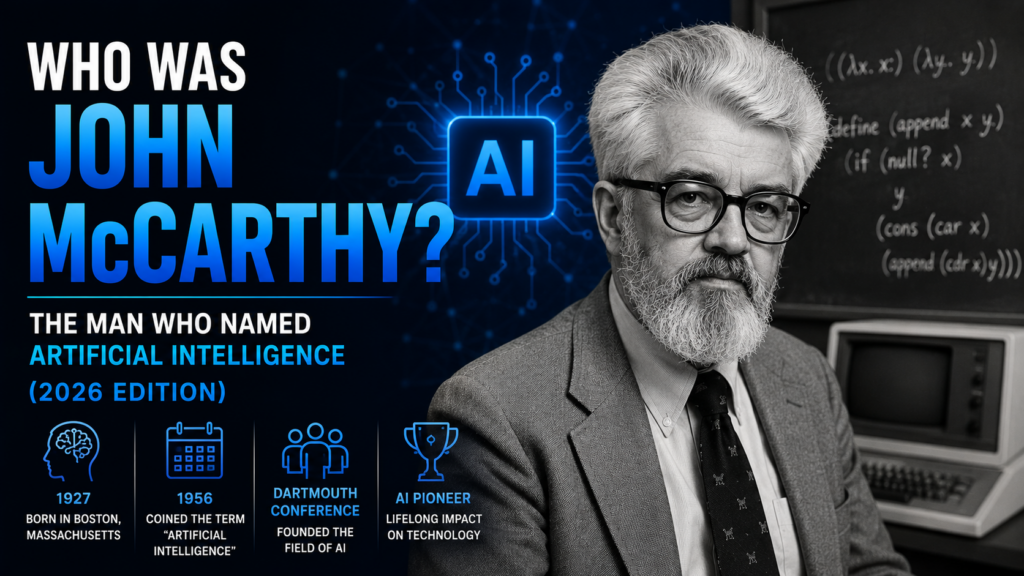
His name was John McCarthy.
If Alan Turing laid the foundation for modern computing, John McCarthy helped transform the dream of intelligent machines into an official field of scientific study.
In fact, he coined the term “Artificial Intelligence”—a phrase that has shaped decades of research, innovation, and technological progress.
Today, AI powers everything from smartphones and search engines to self-driving cars and virtual assistants. But before AI became a household term, John McCarthy helped give the field its identity.
Early Life
John McCarthy was born on September 4, 1927, in Boston, Massachusetts.
From an early age, he displayed an exceptional talent for mathematics and problem-solving.
His curiosity about science and technology eventually led him to study mathematics, where he became fascinated by the possibility of creating machines that could perform tasks traditionally associated with human intelligence.
At a time when computers filled entire rooms and had only a fraction of the power found in today’s smartphones, McCarthy was already imagining a future where machines could learn, reason, and solve problems.
Coining the Term “Artificial Intelligence”
In the mid-1950s, researchers from different fields were exploring ways to make computers perform increasingly complex tasks.
Some studied mathematics.
Others focused on psychology, engineering, or logic.
Although they shared similar goals, there wasn’t a single name that unified their work.
John McCarthy believed the field needed one.
In 1955, while helping organize a summer research project at Dartmouth College, he proposed the term:
Artificial Intelligence
The name was simple, memorable, and broad enough to include many different approaches to creating intelligent machines.
Today, it remains one of the most recognizable phrases in technology.
The Dartmouth Conference
In the summer of 1956, researchers gathered at Dartmouth College in Hanover, New Hampshire, for what is now considered one of the most important events in computer science history.
Known as the Dartmouth Summer Research Project on Artificial Intelligence, the conference brought together brilliant minds who believed computers might one day perform tasks requiring human intelligence.
Participants discussed ideas such as:
- Learning
- Reasoning
- Problem-solving
- Language
- Decision-making
Although the technology of the time was extremely limited, the conference officially established Artificial Intelligence as its own scientific discipline.
Many historians consider this event the birth of AI.
A Vision Far Ahead of His Time
John McCarthy didn’t simply want computers to perform calculations.
He believed they could eventually:
- Learn from experience
- Solve unfamiliar problems
- Understand language
- Make logical decisions
- Assist people in meaningful ways
These ideas sounded incredibly ambitious during the 1950s.
At the time, computers were slow, expensive, and limited in capability.
Many people thought intelligent machines were science fiction.
McCarthy believed otherwise.
Much of what he envisioned has gradually become reality.
Inventing the LISP Programming Language
One of McCarthy’s most significant technical achievements was developing LISP, a programming language introduced in 1958.
LISP quickly became one of the primary languages used for Artificial Intelligence research.
Its flexibility made it well suited for tasks involving symbolic reasoning, problem-solving, and knowledge representation.
For decades, researchers around the world relied on LISP while building many of the earliest AI systems.
Although many newer programming languages are common today, LISP remains an important part of AI history.
The Idea Behind Cloud Computing
Long before the internet became part of everyday life, McCarthy imagined a future where computing power could be delivered as a shared service.
Rather than every person owning an extremely powerful computer, he suggested that computing resources could someday be available much like electricity.
Today, this idea is remarkably familiar.
Cloud computing allows individuals and businesses to access powerful servers over the internet without owning the hardware themselves.
Although many people contributed to the development of cloud computing, McCarthy recognized its potential decades before it became reality.
His Lasting Influence on Artificial Intelligence
John McCarthy spent much of his career encouraging researchers to think boldly.
He believed intelligent machines would eventually become capable of solving increasingly complex problems.
Many of the technologies we use today reflect ideas that researchers like McCarthy discussed decades earlier, including:
- AI assistants
- Robotics
- Machine learning
- Automated reasoning
- Natural language processing
- Intelligent software
While today’s AI systems are far more advanced than anything available during his lifetime, they continue building upon the foundation he helped create.
Recognition and Legacy
Throughout his career, John McCarthy received numerous awards recognizing his contributions to computer science and Artificial Intelligence.
His research influenced generations of scientists, engineers, and software developers.
More importantly, his decision to name the field “Artificial Intelligence” gave researchers a common identity and helped establish AI as one of the world’s most important areas of scientific study.
Today, nearly every major AI breakthrough traces part of its history back to the work of John McCarthy and the ideas shared during the Dartmouth Conference.
Frequently Asked Questions
Who was John McCarthy?
John McCarthy was an American computer scientist and mathematician best known for coining the term Artificial Intelligence and helping establish AI as an official field of scientific research.
Did John McCarthy invent Artificial Intelligence?
No.
Many researchers contributed ideas that shaped Artificial Intelligence.
However, John McCarthy gave the field its name and played a leading role in organizing the 1956 Dartmouth Conference, which officially launched AI as a scientific discipline.
Why is John McCarthy important?
His work helped organize and define the field of Artificial Intelligence.
He also created the LISP programming language and introduced ideas that influenced cloud computing and future AI research.
What is John McCarthy’s greatest contribution?
Many people consider his greatest contribution to be coining the term Artificial Intelligence and helping establish the field through the Dartmouth Conference.
His influence continues to shape AI research today.
Final Thoughts
History often remembers the people who build remarkable inventions.
John McCarthy’s contribution was equally important.
He helped define an entirely new scientific field.
By introducing the term Artificial Intelligence and bringing together researchers who shared that vision, he gave generations of scientists a common goal: creating machines capable of solving problems, learning from experience, and assisting humanity in new ways.
Many of the AI technologies we use today—from virtual assistants and recommendation systems to advanced language models—exist because pioneers like John McCarthy believed intelligent machines were possible long before the technology existed to build them.
His story reminds us that progress doesn’t always begin with a finished invention.
Sometimes it begins with a powerful idea—and the courage to give that idea a name.
As you continue learning about AI, you’ll encounter many remarkable innovators. John McCarthy stands among the most influential because he didn’t just help advance the field—he helped define it.