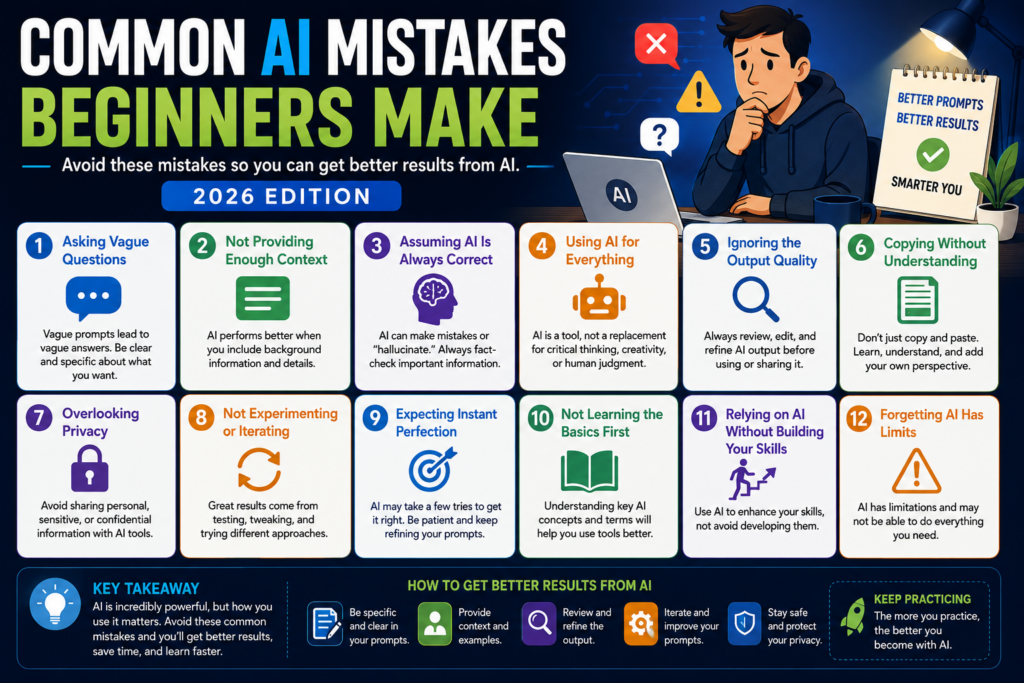
Artificial intelligence is one of the most powerful tools available today.
It can help you write, learn, brainstorm ideas, create images, solve problems, and save countless hours every week.
But if you’re new to AI, it’s easy to make mistakes that lead to poor results or unnecessary frustration.
The good news?
Almost every beginner makes the same mistakes—and they’re all easy to fix once you know what to look for.
In this guide, we’ll explore the most common AI mistakes and show you how to avoid them.
1. Asking Questions That Are Too Vague
One of the biggest mistakes beginners make is giving AI very little information.
For example:
Poor Prompt
Write an article.
The AI has no idea:
- What the topic is
- Who the audience is
- How long it should be
- What tone to use
A better prompt would be:
Write a 1,500-word beginner-friendly article explaining artificial intelligence. Use simple language, headings, FAQs, and a conclusion.
The more helpful information you provide, the better your results will usually be.
2. Trusting Every Answer Without Verifying It
AI is incredibly helpful.
But it isn’t perfect.
Sometimes it can:
- Misunderstand a question
- Present outdated information
- Make factual mistakes
- Confidently provide an incorrect answer
Whenever you’re dealing with important topics such as:
- Health
- Legal issues
- Finances
- Taxes
- Safety
Always verify the information using reliable sources.
Think of AI as a knowledgeable assistant—not an infallible expert.
3. Giving Up After the First Response
Many beginners assume the first answer is the final answer.
Experienced AI users rarely stop there.
Instead, they ask follow-up questions like:
- Explain it more simply.
- Add examples.
- Rewrite this professionally.
- Make it shorter.
- Expand section three.
- Turn this into a checklist.
AI works best as a conversation.
Don’t be afraid to refine the response until it matches exactly what you need.
4. Not Providing Enough Context
AI performs much better when it understands your situation.
Instead of saying:
Help me write an email.
Try:
Help me write a friendly email to my manager requesting Friday off for a family event.
Context allows AI to create much more personalized responses.
5. Sharing Sensitive Information
Never share confidential information with any AI tool.
Avoid entering:
- Passwords
- Social Security numbers
- Credit card numbers
- Bank account information
- Medical records
- Confidential business documents
- Private customer information
Treat AI like any other online service and protect your personal information.
6. Expecting AI to Read Your Mind
AI only knows what you tell it.
If you leave out important details, don’t be surprised if the response misses the mark.
Be clear about:
- Your goal
- Your audience
- The tone
- The format
- Any important requirements
Clear instructions almost always produce better results.
7. Using AI as a Replacement for Learning
AI can explain almost anything.
But simply copying answers without understanding them won’t help you grow.
Instead, use AI to:
- Learn concepts
- Practice new skills
- Ask follow-up questions
- Test your knowledge
- Build confidence
The goal is to learn with AI—not let AI do all the thinking for you.
8. Forgetting to Edit AI-Generated Content
AI is excellent at creating first drafts.
However, your final work should always include your own voice.
Before publishing or submitting AI-generated content:
- Check the facts.
- Fix mistakes.
- Personalize the writing.
- Add your own experiences.
- Remove repetitive wording.
Great writing combines AI efficiency with human judgment.
9. Trying to Do Everything in One Prompt
Some beginners create enormous prompts asking AI to perform ten different tasks at once.
For example:
Write a business plan, create a logo, build a website, write social media posts, and develop a marketing strategy.
Instead, break large projects into smaller conversations.
You’ll receive clearer, more focused responses.
10. Thinking AI Knows Everything
AI has access to an enormous amount of knowledge, but it doesn’t know everything.
It may:
- Lack current information.
- Misinterpret your request.
- Miss important context.
- Produce incomplete answers.
If something seems questionable, ask follow-up questions or verify the information independently.
Healthy curiosity is one of the best ways to use AI responsibly.
Bonus Tips for AI Success
Want to get better results immediately?
Follow these simple habits:
- Be specific.
- Give context.
- Ask follow-up questions.
- Break large tasks into smaller steps.
- Verify important facts.
- Keep experimenting.
- Learn from each conversation.
The more you practice, the better your prompts—and your results—will become.
Frequently Asked Questions
Is it normal to make mistakes when learning AI?
Absolutely.
Everyone starts somewhere.
Even experienced AI users continue discovering new ways to write better prompts and improve their workflow.
Can AI give incorrect answers?
Yes.
AI can sometimes generate inaccurate or outdated information.
That’s why it’s important to verify important facts before relying on them.
Should I use AI for school or work?
Yes—but responsibly.
AI is an excellent tool for brainstorming, learning, organizing ideas, and improving your work.
However, you should always understand, review, and personalize anything AI helps you create.
What’s the best way to become better at using AI?
Practice.
Experiment with different prompts.
Ask follow-up questions.
Learn from each conversation.
Like any skill, using AI becomes easier and more effective with experience.
Final Thoughts
Artificial intelligence is an incredible tool, but like any tool, its value depends on how you use it.
The biggest mistakes beginners make aren’t caused by a lack of intelligence—they’re usually caused by unrealistic expectations or unclear communication.
Fortunately, these mistakes are easy to fix.
By learning to write better prompts, providing useful context, verifying important information, and treating AI as a collaborative partner rather than a perfect answer machine, you’ll get far more value from every conversation.
Remember, becoming skilled with AI isn’t about memorizing commands or learning complex technology.
It’s about learning how to communicate clearly, think critically, and use AI to enhance your own abilities.
Master those habits, and you’ll quickly discover why artificial intelligence has become one of the most valuable productivity tools of the modern era.